
What does the Founders Agreement mean?
A founders’ agreement is a formal agreement executed and agreed to by and between the founders of a startup business outlining everything from roles of each partner to ownership stake in the business to rights to leave the business.
A founders agreement is signed before incorporation or right after. It’s different from a Shareholders’ Agreement (SHA), which comes later, once investors are involved. If you’re still deciding on your entity type, our Private Limited vs LLP guide is a useful starting point before this conversation.
Why Startups Cannot Skip This
Bangalore is home to one of the largest startup ecosystems in the country. Hundreds of startups launch here every month.
As startups move quickly, they also face their share of risks. Founders often start working together informally. They build a product, raise some money, and only think about legal documentation later.
This is risky for a few reasons:
- Verbal agreements are hard to enforce
- Equity disputes can stall fundraising
- Investors expect to see a founders agreement during due diligence
- Co-founder exits without documentation get messy fast
A founders agreement startup India teams build needs is not optional paperwork. It’s a foundational business document, just like your incorporation certificate. We always advise to discuss this matter while making a registration of the company registration in Bangalore.
What An Investor Considers While Carrying Out Due Diligence?
While investing in an early-stage startup, investors do not only consider the product or revenue. They want to make sure the founders have established an effective governance structure.
A sound founders agreement ensures that the founders have clarified such issues as equity ownership, vesting, intellectual property assignment, founder exits, and decision-making authority. If some legislation or documentation is lacking, legal due diligence may take a longer time, and there may arise unnecessary issues related to governance.
What Happens Without a Founders Agreement?
Without this document, founders rely on assumptions. Assumptions break down under pressure. Common problems that arise:
- Disputes over who owns what percentage of the company
- Disagreements over decision-making authority
- No clear process when a co-founder wants to leave
- Confusion over IP ownership (who owns the code, brand, or product)
- Awkward conversations about salary and contribution mismatches
Problems arise after 12-18 months. By this time, the business usually has undergone some development, and the severity of the issue increases. Fixing things without a prior agreement becomes expensive and emotionally draining.
In our practice, the equity dispute is almost always the trigger, not the IP clause or the non-compete. Founders underestimate how quickly “we’ll figure it out later” turns into a deadlock.
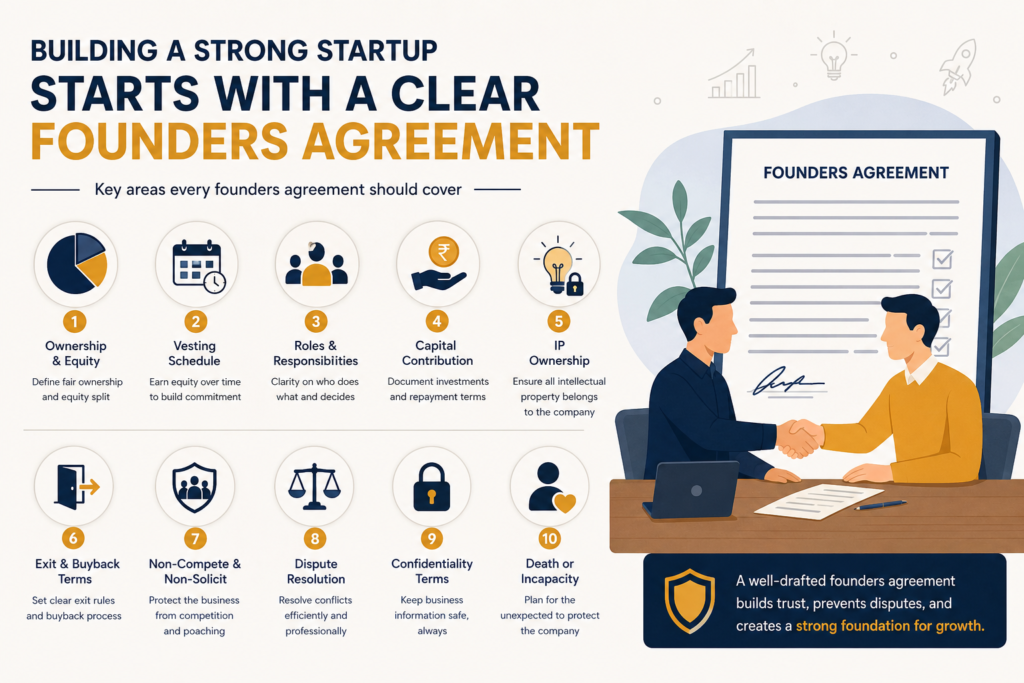
Important clauses in Founders Agreements
A proper Founders Agreement is more than just a formality in business.
1. Equity Split
This is the most sensitive part of any founders agreement. Co-founder equity split India disputes are one of the top reasons startups fail early.
- Your agreement should clearly mention:
- Percentage of equity held by each founder
- Basis of the split (capital contribution, idea, technical work, time commitment)
- Whether the split is fixed or subject to revision
2. Vesting Schedule
Equity should not be handed out in full on day one. A vesting schedule protects the company if a founder leaves early. A standard structure looks like this:
- 4-year vesting period
- 1-year cliff (no equity is released before this point)
- Monthly or quarterly vesting after the cliff
This protects the company from a founder who exits after six months but still holds a large equity stake. We’ve seen Indian founders skip the cliff entirely, assuming “trust” will substitute for structure it rarely does once real money is on the table.
3. Roles and Responsibilities
Define who does what. This avoids overlap and confusion. Common roles to define:
- Decision-making authority for each function (product, finance, operations)
- Who has final say in case of disagreement
- Reporting structure if there are more than 2 founders
4. Capital Contribution
If founders are putting in personal funds, this needs documentation. Mention:
- Amount contributed by each founder
- Whether it’s a loan or capital infusion
- Repayment terms, if applicable
5. IP Ownership
This protects the most important asset of any start-up – the Intellectual property:
- All IP created by founders belongs to the company, not the individual
- This applies even if a founder built something before incorporation
- Founders assign their personal IP related to the business to the company
6. Founder Exit and Buyback Clause
This is where most disputes happen. A clear exit clause prevents long legal battles. Your agreement should define:
- What happens if a founder voluntarily leaves
- What happens if a founder is asked to leave
- Buyback price formula for unvested or vested shares
- Notice period required before exit
7. Non-Compete and Non-Solicit
This clause prevents a founder from leaving the company and starting a competing business, while taking with him/her the company’s clients’ details, data, and team members.:
- Duration of restriction (commonly 1-2 years)
- Geographic scope
- Definition of “competing business”
8. Dispute Resolution
Disagreements are normal. The agreement should define how to resolve them without going straight to court. Common methods:
- Mediation first
- Arbitration as a second step
- Jurisdiction and governing law clause
9. Confidentiality
Founders often discuss sensitive information. This term ensures that no leaks happen, even after the departure of the founder.
10. Death or Incapacity
This is rarely discussed but important. It defines what happens to a founder’s equity if they pass away or become incapacitated.
Founders Agreement vs Shareholders’ Agreement
These two documents are often confused. Here’s the difference.
Founders Agreement
- Signed early, often before incorporation
- Between co-founders only
- Covers internal matters like equity, roles, and exit
Shareholders’ Agreement (SHA)
- Signed later, usually during a funding round
- Includes investors as signatories
- Covers investor rights, board structures, and exit mechanisms
Both documents matter, but the founders agreement comes first, it sets the foundation the SHA later builds on. If your startup is heading into a funding round, our Shareholders’ Agreement services page covers what that process involves.
Do You Need a Founders Agreement Before Incorporation?
Yes. It is best to sign this before forming your company:
- It forces founders to discuss sensitive topics early
- It avoids assumptions that turn into disputes later
- It becomes a reference document during incorporation and fundraising
- Investors and DPIIT reviewers during recognition, often ask for it during due diligence
If you have already incorporated your business, you can still draft your agreement. It is better late than never.
Is a Founders Agreement Legally Binding in India?
A Founders Agreement is a contract enforceable by Indian Contract Act, 1872, as long as it fulfills the criteria of a valid contract
- Free consent of all parties
- Lawful consideration
- Lawful object
- Capacity to contract
It should be signed by all founders and ideally notarized or registered, depending on the clauses involved, especially if it includes IP assignment or non-compete terms with monetary value.
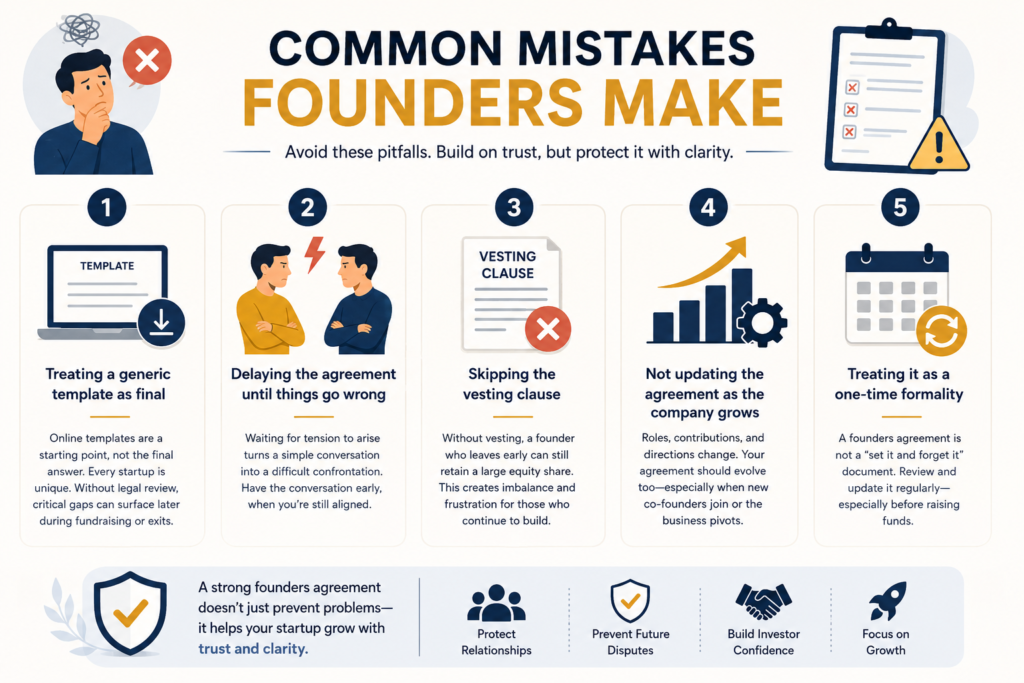
Common Mistakes Founders Make
1. Treating a generic template as final
A founders agreement template found online is a reasonable starting point for understanding structure. But every startup has different equity splits, roles, and risk areas. Using a generic template without legal review can leave gaps that surface later, usually at the worst possible time, during fundraising or a co-founder exit.
2. Delaying the agreement until things go wrong
Often founders wait until they feel tension to have any talks about equity and roles, which will end up as an adversarial process rather than a cooperative one.
3. Skipping the vesting clause
A founder who leaves early will not have a vesting system, which allows them to maintain a sizable equity share. This creates problems for founders who remain and keep working.
4. Not updating the agreement as the company grows
Roles change. Contributions change. If the situation changes significantly, the agreement has to be revised, for example, when a new co-founder comes in or changes direction.
5. Treating it as a one-time formality
Founders agreements are documents that need to be updated periodically, especially right before getting external funding.
When Should You Revisit Your Founders Agreement?
- A new co-founder joins
- Equity contribution changes significantly
- The company pivots to a different business model
- You’re about to raise your first round of funding
- A founder’s role or responsibility changes substantially
Treat it as a living document, not a one-time signature.
Conclusion
A startup founders agreement is not merely a formality. It is the rock on which your startup will be built.
It safeguards your shares and intellectual property and protects your relationship with your co-founders. It assists you in forestalling possible conflicts that could hinder the development of your business during its crucial stages.
If your startup is in Bangalore, don’t wait for the first disagreement to solve the issue. Check the Contract Drafting Services we offer and get your startup founding agreement drafted well before day one.
No matter if you are looking for a startup founders agreement or want to get clarity regarding the co-founders share distribution principles or just want to understand the essence of a startup founding agreement and what role it plays in your protection, realizing the importance of doing it early will do its work.
Frequently Asked Questions
Is a founders agreement legally required in India?
Though not legally required, it is recommended. Judges and those working in corporate law regard it as a convention, and resolving disputes that do not have one can be a challenge.
When should founders sign this agreement?
Ideally before incorporation, or immediately after. The earlier it’s signed, the fewer assumptions exist between founders.
Can a founders agreement be changed later?
Yes, every time equity, roles or contributions see substantial modifications, the agreement should be revised, for instance, when a new co-founder moves in.
Is a founders agreement the same as a Shareholders’ Agreement?
No. A founders agreement is signed early between co-founders. Shareholders agreement is signed after raising funds and putting the investors into the document.
Is there a standard founders agreement India PDF template I can use?
There are some universal templates available, but they do not reflect most organizations’ equity splits, vesting schedules, and problematic areas. You can use our checklist to figure out what does your document require.