What a Board Resolution Does
A board resolution is the written record of a decision the board of directors formally made. It is not a suggestion or a summaryit is the legal proof that the board considered something and approved it on a specific date with the required number of directors present. Banks, investors and regulators don’t take a founder’s word that a decision was made; they ask for the resolution.
This is where founders sometimes misjudge the risk. A verbal agreement among directors, even a unanimous one, carries no legal weight until it is written down and passed as a formal board resolution.
When Is a Board Resolution Legally Required?
Not every internal decision needs one, but more situations require one than most founders expect:
-
- Opening or closing a bank account or changing authorised signatories.
- Approving related party transactions.
- Allotment of shares or any change in share capital.
- Appointment or removal of directors, key managerial personnel or auditors.
- Borrowing money or creating a charge on company assets.
- Approving financial statements before they go to shareholders.
- Entering into contracts above a certain value as defined in the company’s own policies.
We tell founders to check this list before every major transaction and not after. A resolution passed after the fact, backdated to look proper, creates more legal risk than the missing resolution ever did.
Getting the Board Resolution Format Right
A board resolution isn’t just “we agreed to do.” A properly drafted one includes:
-
- The date and place of the meeting.
- The directors present.
- Confirmation of the quorum.
- The exact wording of what was resolved.
- The authorised signatory, where relevant.
Why Vague Board Resolutions Create Problems
Vague resolutions cause almost as many problems as missing ones. We have reviewed resolutions that authorised the company to enter into an agreement without naming the agreement, the counterparty or the person signing on the company’s behalf, and a bank or investor’s legal team will flag exactly the gap during diligence.
What’s Required in Minutes of Meeting Under Company Law?
Board resolutions get passed inside a meeting and that meeting needs its own record the minutes.
Under company law, minutes of meetings must be entered in the minutes book within 30 days of the meeting and, once entered and signed, they become legal evidence of what took place.
Common Mistakes Found in Board Minutes
A few things founders often get wrong here:
-
- Minutes recorded weeks or months late, well past the legal window.
- Minutes that summarise the discussion but skip the actual resolution wording.
- A minutes book that exists digitally but was never properly maintained or numbered.
- No signature from the chairperson within the required time frame.
Once minutes are signed, they are treated as conclusive evidence of the proceedings, which is exactly why getting them right and on time matters more than most founders assume.
Board Resolution vs Shareholder Resolution: Why the Difference Matters
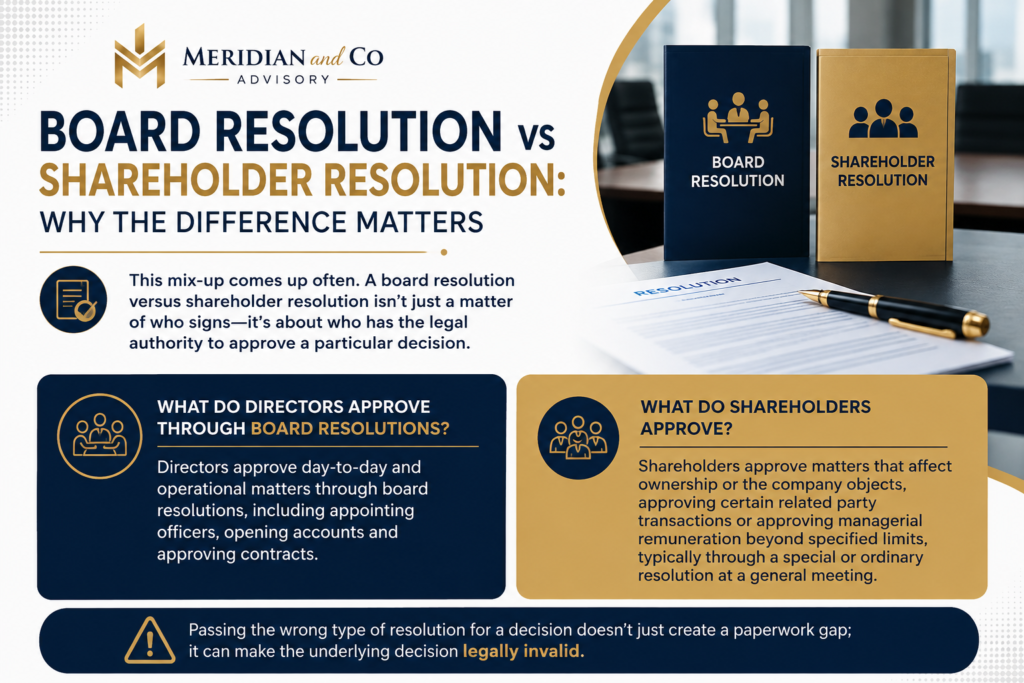
This mix-up comes up often. A board resolution versus shareholder resolution isn’t just a matter of who signsit’s about who has the legal authority to approve a particular decision.
What Do Directors Approve Through Board Resolutions?
Directors approve day-to-day and operational matters through board resolutions, including appointing officers, opening accounts and approving contracts.
What Do Shareholders Approve?
Shareholders approve matters that affect ownership or the company objects, approving certain related party transactions or approving managerial remuneration beyond specified limits, typically through a special or ordinary resolution at a general meeting.
Passing the wrong type of resolution for a decision doesn’t just create a paperwork gap; it can make the underlying decision legally invalid.
What Do Missing or Incorrect Minutes Cost You?
This is a part founders underestimate the most.
During a Funding Round
During a funding round, an investor’s legal team will ask for board resolutions and resolutions going back to incorporation.
During a Statutory Audit
During the statutory audit, missed minutes can be flagged as a compliance lapse.
During an ROC Inspection
During an ROC inspection, an improperly maintained minutes book can attract penalties on the company and its officers.
We have seen deals slow down for weeks while a company reconstructs board resolutions retroactivelya process that is legally shaky at best and creates a real doubt in an investor’s mind about how carefully the company has been run.
One client came to us mid-funding round needing three years of resolution rebuild from email threads and WhatsApp messages because nothing had ever been formally recorded. We got it done, but it cost the founder negotiating leverage at exactly the moment they needed it the most.
A Practical Way to Stay on Top of Board Documentation
The companies that never scramble over this treat documentation as part of the meeting itself, not a task for later:
-
- Record minutes within days, not weeks, and get them signed on time.
- Draft the resolution before the meeting, not after the decision is made.
- Maintain a single, properly numbered minutes book, physical or digital.
- Review past resolutions every year to confirm nothing critical was missed.
- Know which decisions need a board resolution and which need a shareholder resolution before the meeting happens.
Resolution by Circulation: A Shortcut That Gets Misused Often
Not every board decision needs a formal meeting. Company law allows certain resolutions to be passed by circulation to directors individually for approval instead of being discussed in a meeting.
We use this ourselves for routine, time-sensitive matters, and it is a legitimate shortcut when used correctly.
When Resolution by Circulation Becomes a Problem
The mistake we see repeatedly is treating circulation as a workaround for matters that legally require a meeting. Certain matters, like approving financial statements, or matters specifically excluded under company law, cannot be passed by circulation no matter how urgent they feel.
A resolution circulated for a decision that legally needed a meeting is not just informalit is invalid, and that invalidity surfaces at the worst possible time, usually during diligence and not before.
Where We Come In
Board resolutions and minutes aren’t paperwork you catch up on later. They are the record that protects your company when a bank, investor or regulator asks the one question every founder eventually faces: can you prove this decision was made properly?
We help companies build a documentation habit that holds up under scrutiny, not just one that looks complete on the surface. If your board’s paperwork needs a proper review, we are always open to a conversation.
Need Help Reviewing Your Board Resolutions and Minutes?
Board resolutions and minutes should be accurate, timely, and properly maintained not reconstructed when a funding round, audit, or regulatory review is already underway.
If your company’s board documentation needs a review, Meridian & Co Advisory can help you assess your resolutions, minutes, and corporate compliance requirements.