
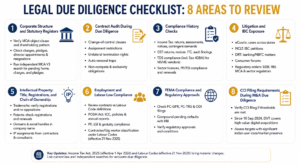
Legal Due Diligence Checklist: 8 Areas to Review
| Area | What to investigate | Typical red flags |
| Corporate structure | Ownership, capitalisation, statutory records, charges | Unexplained ownership, unregistered changes, undisclosed charges |
| Material contracts | Change of control, assignment, termination and exclusivity | Consent requirements, termination rights |
| Tax and regulatory compliance | Income tax, GST, TDS, licences and sector compliance | Notices, defaults, expired licences |
| Litigation and insolvency | Courts, NCLT, DRT and regulatory proceedings | Undisclosed claims or insolvency proceedings |
| IP and technology | Ownership, registrations, assignments and licences | Founder-owned IP, expired rights |
| Employment and labour | Contracts, wages, PF/ESI, POSH and workforce classification | Misclassification, contribution defaults |
| FEMA, FDI and competition | Foreign investment, reporting and CCI requirements | Missed filings, approval gaps |
| Data, cybersecurity and sector regulation | Privacy, security, licences and industry-specific rules | Data breaches, regulatory gaps, non-transferable approvals |
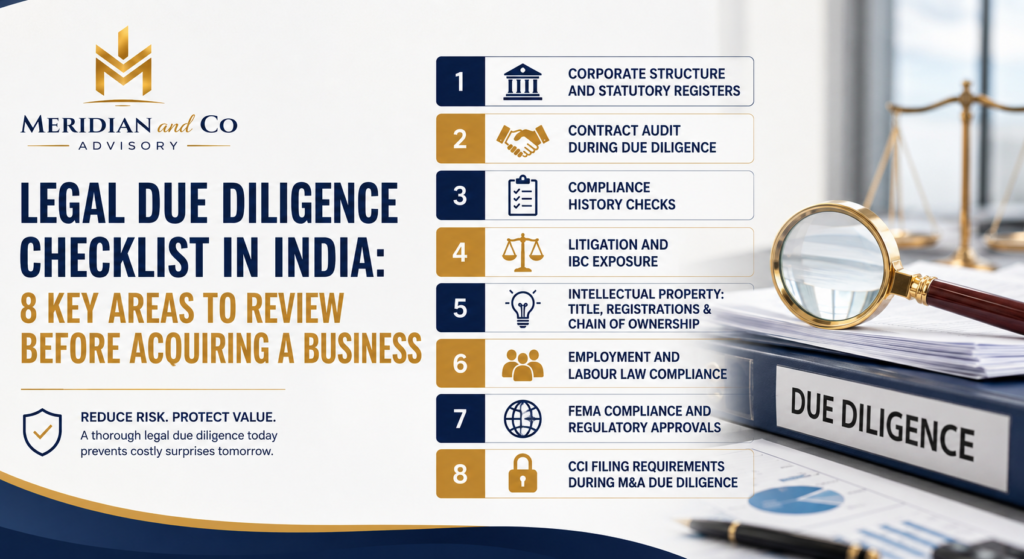
1. Corporate Structure and Statutory Registers
- Download the target company’s documents directly from the MCA V3 portal do not rely solely on what the seller provides.
- Verify the MOA’s object clause covers the actual business being conducted, the current shareholding pattern against the register of members, all charges registered against the company, and the history of director appointments and resignations.
At Meridian and Co, we run an independent MCA V3 search on every target before reviewing a single document the seller has produced. The portal reveals pledges on shares, pending forms, and charge registrations that do not surface in a seller-curated data room.
2. Contract Audit During Due Diligence
A contract audit during due diligence is not the same as collecting a list of agreements. It is a clause-level review of every material contract for provisions that change on a change of control.
What Should You Check in Every Material Contract?
The specific provisions to identify in every material contract:
-
- Change-of-control clauses do any key contracts terminate automatically or require third-party consent if the shareholding changes? This is especially common in enterprise SaaS agreements, government contracts, and exclusive distribution arrangements.
- Assignment restrictions can the target assign its rights under the contract to the acquirer entity?
- Unilateral termination rights does any counterparty have a right to terminate on notice without cause? If so, and the contract is material to the business case, the deal economics may need to be revisited.
- Auto-renewal traps long trail vendor commitments that survive the acquisition and cannot be exited without penalty.
- Non-compete and exclusivity obligations restrictions that limit what the target can do post-acquisition or that bind the acquirer.
3. Compliance History Checks
Compliance history checks are not backward-looking formalities. Inherited compliance failure becomes the acquirer’s problem on closing and regulators do not accept ‘we didn’t know’ as a defence.
What Should You Review in the Compliance History?
-
- Income Tax filed returns for the last 3-5 years, pending assessments, notices under Sections 143 or 148, contingent tax demands.
Note: The Income Tax Act, 2025 (effective April 1, 2026) overhauled provisions relevant to M&A tax treatment verify the target’s tax position under the new Act.
-
- GST GSTR-1, GSTR-3B, and GSTR-9 filing history; pending notices; Input Tax Credit reversals; GST audit findings.
- TDS Compliance TDS deducted, deposited, and filed on time; any defaults on vendor payments (particularly MSME vendors under Section 43B(h), effective April 2024).
- Sector-specific licences FSSAI, drug licences, environment clearances, telecom licences, NBFC registrations, verify validity, transfer conditions, and renewal history.
- Provident Fund and ESI contribution history and any enforcement proceedings.
4. Litigation and IBC Exposure
Run independent litigation searches do not rely on the seller’s disclosure schedule alone.
Where Should You Search for Litigation and IBC Exposure?
-
- eCourts portal district and high court case status across all states where the company operates.
- National Company Law Tribunal (NCLT) check for any pending insolvency petition under the Insolvency and Bankruptcy Code, 2016 (IBC).
- Debt Recovery Tribunals (DRT) relevant if the target has any banking or NBFC borrowings.
- Consumer forums particularly relevant for consumer-facing businesses in healthcare, food, and financial services.
- Regulatory orders SEBI, RBI, MCA, and sector regulator enforcement databases.
5. Intellectual Property: Title, Registrations, and Chain of Ownership
Intellectual property due diligence has two distinct components: registered IP (what exists on paper) and unregistered IP title (who actually owns it in law). Both must be verified.
What Should You Check During Intellectual Property Due Diligence?
- Trademarks search the Trademarks Registry for all marks used by the business; verify no lapse or pending opposition.
- Patents check Indian Patent Office database; verify renewal fees are current.
- Domain names and social media handles confirm registered in the company’s name, not a founder’s personal account.
- Software and technology verify no open-source licence obligations that could affect commercialisation.
- Contractor IP assignments all work product created by freelancers, agencies, or consultants must have been assigned to the company in writing. Without an express assignment, the creator retains copyright under Indian law regardless of payment.
6. Employment and Labour Law Compliance
This area changed materially in late 2025. The four Labour Codes the Code on Wages 2019, the Industrial Relations Code 2020, the Code on Social Security 2020, and the Occupational Safety, Health and Working Conditions Code 2020 came into force across India on November 21, 2025, consolidating 29 earlier central labour laws.
Any due diligence conducted before this date or using a pre-2025 checklist will not capture Labour Code compliance gaps.
What Should You Review for Employment and Labour Compliance?
Review: employment contracts and offer letters against Labour Code definitions of ‘worker’ and ‘employees’; POSH Act compliance including Internal Complaints Committee constitution and annual reports; PF, ESI, and gratuity contribution history; contractor and gig worker classification against the new Code on Social Security definitions.
7. FEMA Compliance and Regulatory Approvals
For any target that has received foreign investment or has foreign shareholders, FEMA compliance history is non-negotiable due diligence territory.
Missed FC-GPR filings (equity issuances to foreign investors), FC-TRS filings, or ODI filings must be compounded with the RBI before the deal can proceed and compounding takes time and attracts penalties.
CCI Filing Requirements During M&A Due Diligence
For deals above the CCI notification thresholds, also verify CCI filing requirements.
Since September 10, 2024, the Deal Value Threshold (DVT) has brought high-value digital acquisitions into mandatory CCI review even where the target’s Indian turnover is below the traditional threshold.
Any acquisition of a target with significant Indian user data or digital market presence must be assessed against the DVT.
Documents to Request During Legal Due Diligence
| Category | Documents / Records to Include |
| Corporate | MOA/AOA |
| Certificate of Incorporation | |
| Statutory Registers | |
| Shareholding Records | |
| Board/Shareholder Minutes | |
| MCA Filings | |
| Charge Documents | |
| Shareholder Agreements | |
| Commercial Contracts | Top Customer Agreements |
| Vendor Agreements | |
| Technology Agreements | |
| Distribution Arrangements | |
| Leases | |
| Financing Agreements | |
| Government Contracts | |
| Strategic Partnerships | |
| Tax | Income-Tax Returns |
| Assessments | |
| Notices | |
| GST Returns | |
| GST Notices | |
| TDS Records | |
| Tax Litigation | |
| Outstanding Demands | |
| Litigation | Litigation Schedule |
| Pleadings | |
| Orders | |
| Notices | |
| Settlement Agreements | |
| Regulatory Proceedings | |
| IP and Technology | Trademark Certificates |
| Patent Records | |
| Copyright Records | |
| IP Assignments | |
| Licence Agreements | |
| Software Agreements | |
| Domain Ownership Information | |
| Employment | Employee Agreements |
| Payroll Records | |
| PF/ESI Records | |
| Gratuity Records | |
| POSH Records | |
| Contractor Arrangements | |
| ESOP Documentation | |
| FEMA and Regulatory | FC-GPR |
| FC-TRS | |
| ODI Records | |
| RBI Correspondence | |
| Regulatory Licences | |
| CCI Analysis/Filings | |
| Sector-Specific Approvals | |
| Data and Cybersecurity | Privacy Policies |
| Data-Processing Agreements | |
| Security Policies | |
| Incident Reports | |
| Cyber Insurance | |
| Security Audit Reports |
What Happens When Legal Due Diligence Finds a Problem?
Not every diligence finding requires the buyer to walk away.
Depending on the nature of the issue, the parties may use:
-
- Condition precedent: Require the seller to resolve the issue before closing.
- Specific indemnity: Allocate a known liability to the seller.
- Escrow or retention: Hold back part of the purchase price against potential exposure.
- Purchase-price adjustment: Reflect the quantified risk in valuation.
- Representation and warranty: Obtain contractual protection against undisclosed problems.
- Transaction restructuring: Change the acquisition structure if the legal issue cannot be solved through the original structure.
- Termination: If the risk is fundamental and cannot be mitigated economically, the buyer may decide not to proceed.
This is why legal due diligence should begin early enough to influence the transactionnot merely validate it after commercial terms have already been agreed.
How Legal Due Diligence Has Changed in 2026
A pre-2025 checklist is no longer sufficient for many Indian transactions.
Three developments are particularly important.
1. Labour Codes
The four Labour Codes became effective on 21 November 2025, consolidating 29 central labour laws. Employment diligence should therefore assess the target’s workforce against the new framework and the rules applicable to its operations.
2. Income-tax Act, 2025
The Income-tax Act, 2025 came into force on 1 April 2026. At the same time, its repeal-and-savings provisions preserve the application of the earlier Act to specified pre-1 April 2026 tax years and proceedings. Tax diligence therefore needs a transition analysis rather than a simple “old Act versus new Act” approach.
3. CCI Deal Value Threshold
The 2024 competition framework introduced the DVT, making transaction value and the target’s substantial business operations in India relevant even in transactions where traditional asset/turnover analysis alone might not identify a filing requirement.
Conclusion
Legal due diligence is not a document collection exercise. It is a risk-mapping exercise that determines whether the target’s legal rights, revenue relationships and operations can survive the transaction intact.
Before I invest in or acquire a business in India I will review the structure, main contracts, tax obligations, regulatory compliance, litigation and insolvency risks intellectual property, employee duties, FEMA and competition rules and data privacy and sector‑specific laws.
The valuable diligence finding is not necessarily the one that kills the deal. The valuable diligence finding is the one that is discovered early enough to change the deal on informed terms. That may mean negotiating a valuation obtaining a regulatory approval securing a contractual consent requiring remediation, before closing obtaining a specific indemnity or restructuring the transaction.
