
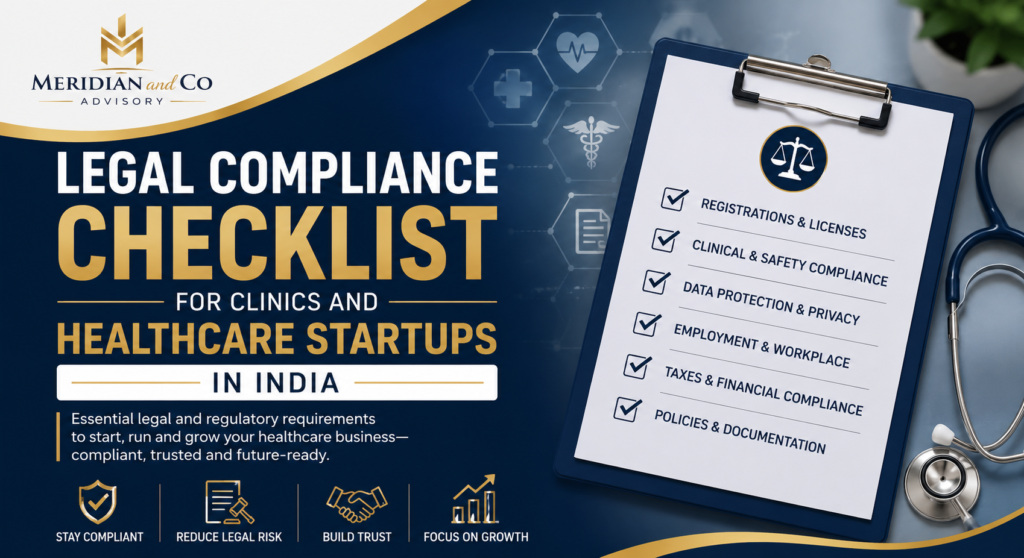
Why Healthcare Compliance Works Differently
Most businesses in India deal with one or two primary regulators. Healthcare compliance for businesses often answer to several authorities at the same time.
Depending on the nature and location of the business, this can involve:
- State health authorities
- Local municipal authorities
- Medical regulators and professional councils
- Pollution control and biomedical waste authorities
- Fire and safety authorities
- Labour authorities
- Tax authorities
- Data protection and technology-related requirements
- Sector-specific regulators
Each requirement can have its own registration process, renewal cycle, documentation requirements and consequences for non-compliance.
We have seen founders assume that getting one licence or registration sorted means they are done. Months later, they discover that a completely separate registration or approval was also required.
That is why healthcare business compliance is rarely difficult because of one complicated requirement. It becomes difficult because there are too many moving pieces to track without a proper checklist.
A Common Compliance Gap We See
We once had a founder approach us convinced that her diagnostic centre was fully compliant.
The biomedical waste arrangement was in place. The doctors were properly registered. The basic operational requirements appeared to be covered.
But one important question had not been checked: was the healthcare establishment itself properly registered under the applicable state or local framework?
That distinction matters.
A doctor’s professional registration and the legal registration of the establishment are not necessarily the same thing.
Clinical Establishment Registration: One of the Most Commonly Missed Requirements
Depending on the state, location and type of facility, a clinic, nursing home, diagnostic centre, hospital or polyclinic may need establishment-level registration under the applicable clinical establishment framework.
The exact requirements depend on the state and the nature of the facility. Karnataka and other states may have their own state-specific requirements, so founders should confirm the rules that actually apply to their establishment rather than assuming that one central framework covers every situation.
Before opening, check whether your facility requires:
- Clinical establishment registration with the applicable state or local health authority
- Compliance with prescribed infrastructure standards
- Appropriate staffing and qualification requirements
- Required equipment and facility standards
- Biomedical waste management arrangements and authorisations
- Fire safety approval or NOC, where applicable
- Premises and signage compliance
- Any additional local registrations or permissions
Medical Practitioner Registration Is Not the Same as Clinical Establishment Registration
This is one of the most common areas of confusion.
A doctor’s professional registration allows that individual to practise medicine in accordance with the applicable professional and regulatory framework. It does not automatically register the clinic, hospital, diagnostic centre or other healthcare establishment.
The two should therefore be checked separately.
For every doctor working at the facility, verify that:
- The doctor holds the required professional registration
- The registration is current
- The doctor’s registration details are properly maintained
- Prescriptions and professional documents contain the required registration information
- Any applicable professional requirements are being followed
The National Medical Commission’s regulatory framework requires registered medical practitioners to comply with professional and ethical obligations, including requirements relating to registration and medical records.
A clinic should therefore maintain a proper record of the professional registrations of all doctors working there instead of relying on informal verification.
What Telemedicine and Health Tech Startups Need to Check
Telemedicine creates a second layer of compliance because the healthcare service is being delivered through a technology platform.
The applicable telemedicine framework addresses areas such as the doctor-patient relationship, informed consent, medical records, privacy, security, prescribing and professional responsibilities.
For a telemedicine or health tech platform, review at least the following:
- Registered medical practitioners providing consultations
- Verification of professional registration
- Patient identification and onboarding processes
- Consent processes for teleconsultations
- Medical record creation and retention
- Prescription workflows
- Restrictions applicable to remote prescribing
- Referral and emergency-care processes
- Privacy and security controls
- Patient communication and grievance processes
- Contracts with doctors, technology providers and other service partners
The platform should not assume that having qualified doctors on board automatically makes the technology compliant.
The medical side and the technology side need to work together.
Why Consent and Record-Keeping Matter
Telemedicine guidelines specifically address informed consent, medical records, privacy and security of patient information.
That means a platform should examine what happens at every stage:
- Patient signs up
- Patient understands the service
- Consent is captured where required
- Consultation takes place
- Records are created
- Prescription is issued where permitted
- Information is stored securely
A weak link anywhere in that chain can create avoidable compliance and operational risk.
Data Privacy: A Growing Compliance Issue for Health Tech
Healthcare businesses routinely collect information that can be highly sensitive to the individual, including medical records, diagnostic information, prescriptions and other health-related information.
For health tech businesses, data privacy compliance should therefore be considered at the product-design stage rather than treated as a document to add after launch.
The applicable data protection framework should be reviewed based on the business model, the nature of the data processed, the parties involved and the role of the organisation in processing that data.
A practical privacy review should cover:
- What personal data the platform collects
- Why each category of data is collected
- The applicable legal basis and consent requirements
- Patient-facing privacy notices
- Data retention and deletion practices
- Access controls for employees and service providers
- Contracts with third-party processors and vendors
- Security safeguards
- Data breach response procedures
- Patient or data-principal rights and related processes
- Cross-border data considerations, where applicable
Do not wait until the platform has thousands of users to start asking these questions.
We tell health tech founders the same thing we tell any business handling sensitive customer information: build privacy and security into the product from day one.
Retrofitting a consent process, privacy framework or data governance system after the product is already live is usually much harder than designing it correctly at the beginning.
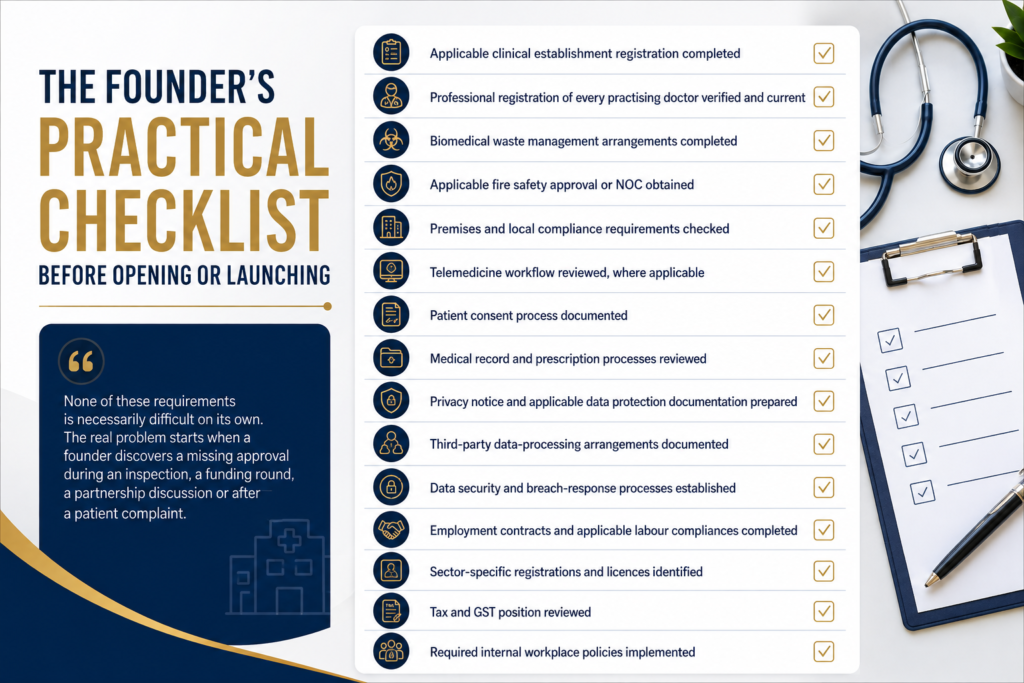
The Founder’s Practical Checklist Before Opening or Launching
Based on the compliance gaps we repeatedly see, this is what we would want every clinic or health tech founder to confirm before going live:
-
- Applicable clinical establishment registration completed
- Professional registration of every practising doctor verified and current
- Biomedical waste management arrangements completed
- Applicable fire safety approval or NOC obtained
- Premises and local compliance requirements checked
- Telemedicine workflow reviewed, where applicable
- Patient consent process documented
- Medical record and prescription processes reviewed
- Privacy notice and applicable data protection documentation prepared
- Third-party data-processing arrangements documented
- Data security and breach-response processes established
- Employment contracts and applicable labour compliances completed
- Sector-specific registrations and licences identified
- Tax and GST position reviewed
- Required internal workplace policies implemented
None of these requirements is necessarily difficult on its own.
The real problem starts when a founder discovers a missing approval during an inspection, a funding round, a partnership discussion or after a patient complaint.
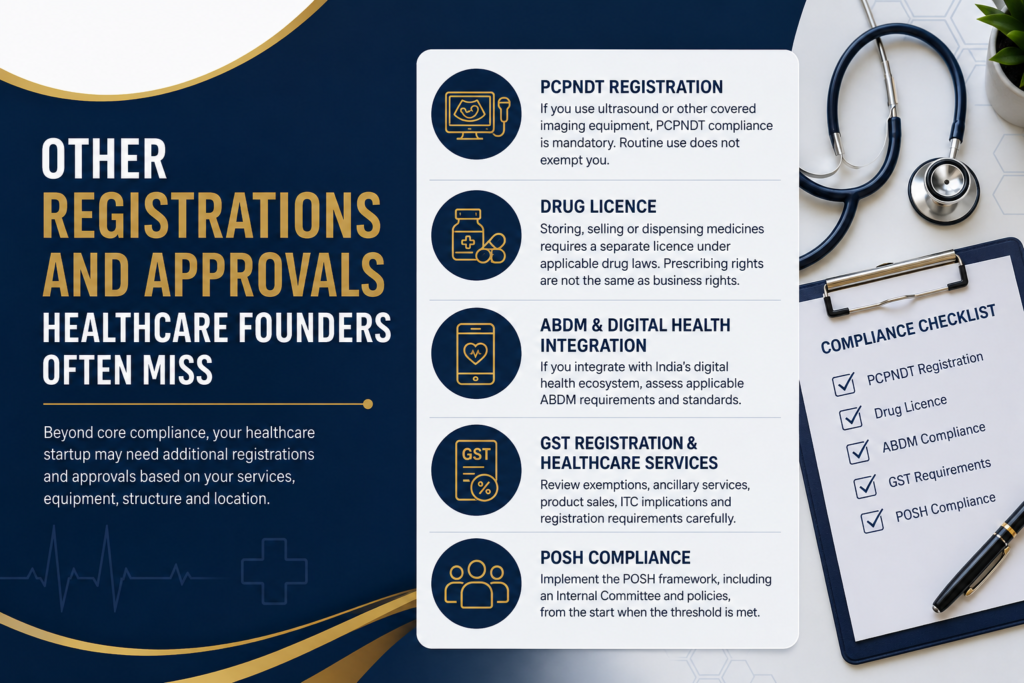
Other Registrations and Approvals Healthcare Founders Often Miss
The core compliance requirements are only part of the picture.
Depending on the services offered, equipment used, business structure and location, additional registrations or approvals may apply.
PCPNDT Registration
If a facility uses ultrasound or other applicable imaging equipment covered by the Pre-Conception and Pre-Natal Diagnostic Techniques (Prohibition of Sex Selection) Act, PCPNDT compliance needs careful attention.
This is particularly important for establishments using ultrasound or other covered diagnostic techniques.
Do not assume that routine diagnostic use eliminates PCPNDT obligations.
Drug Licence
A clinic or hospital that stores, sells or dispenses medicines may have additional requirements under applicable drug laws.
A doctor’s authority to prescribe medicines is not the same as a business’s authority to stock or dispense medicines.
The exact licensing requirements depend on what the establishment does and how medicines are handled.
ABDM and Digital Health Integration
Healthcare technology businesses integrating with India’s digital health ecosystem should assess whether they need to comply with applicable ABDM-related requirements, technical standards or participation conditions.
ABDM-related compliance should not be treated as a blanket registration requirement for every healthcare startup. The applicable requirements depend on what the platform does and which digital health services or integrations it uses.
GST Registration and Healthcare Services
Healthcare services can receive specific GST treatment, including exemptions in qualifying circumstances.
However, not every activity performed by a healthcare business necessarily receives identical treatment.
A clinic or health tech business should therefore review:
- Nature of services provided
- Whether the service qualifies for an exemption
- Revenue from non-healthcare services
- Ancillary services
- Products or medicines sold separately
- Input tax credit implications
- GST registration requirements
Getting the GST treatment wrong can result in unnecessary tax costs or future compliance exposure.
POSH Compliance
Healthcare businesses are workplaces, and applicable workplace-harassment prevention requirements need to be considered from the beginning.
Where the statutory threshold is met, the organisation needs to implement the required POSH Compliance framework, including an Internal Committee and related policies and processes.
Do not wait until the organisation grows significantly before putting workplace compliance in place.
The Compliance Conversation That Changes at Series A
There is a moment we see repeat itself with almost every funded health tech founder we work with, and it rarely comes up when the business is just starting out.
It happens during due diligence.
An investor’s legal team, or a hospital network evaluating a partnership, or a TPA reviewing empanelment, starts asking for documents the founder assumed were internal the establishment registration, the biomedical waste contract, the telemedicine consent workflow, the data processing agreements with vendors. Not because anyone suspects wrongdoing, but because for a healthcare business, these documents are now treated as basic proof that the business is what it claims to be.
We have watched two very different versions of this moment play out.
In one, the founder has a folder ready. Registrations current, contracts signed, privacy documentation in place. The diligence process moves quickly, and the compliance conversation barely slows the deal down.
In the other, the founder is compliant in spirit but not on paper the biomedical waste vendor was engaged informally, the consent flow was never documented, the privacy notice was copied from another website and never reviewed against the actual product. None of it was necessarily unlawful. But it took weeks to reconstruct, and in one case, it delayed a funding round by an entire quarter while the paperwork caught up with reality.
The lesson we take away from this, and one we repeat often, is that compliance built early does not just reduce legal risk. It becomes evidence the kind that a founder can hand over in a single email rather than assembling under pressure while a term sheet sits on the table.
Why Healthcare Founders Should Build Compliance Before Launch
Founders usually plan for the registrations they have heard about. The problems often come from the requirements nobody mentioned during the initial setup. An ultrasound machine purchased for routine diagnostics can raise PCPNDT compliance questions. A technology platform that collects patient information can create privacy and data-governance obligations.
A clinic employing doctors can have professional-registration requirements as well as establishment-level requirements. A business dispensing medicines can have additional drug-law considerations. That is why healthcare compliance should not be approached as a one-time registration exercise.
It should be treated as an ongoing compliance system.
Conclusion
Healthcare startup legal compliance in India is not a one-time checklist that you complete and forget.
Regulations change. State-specific requirements differ. A clinic may expand its services. A health tech platform may introduce a new feature. The business may start collecting a new category of patient information. The organisation may cross a threshold that triggers an additional workplace or regulatory requirement.
Each of these changes can create a new compliance question.
We help clinic owners, healthcare businesses and health tech founders identify the legal and regulatory requirements that apply to their business and build a practical compliance structure around them.
If you are setting up a clinic, expanding a healthcare facility or launching a health tech platform, it is better to get this right before you open the doors than to reconstruct it under pressure later. Meridian and Co. Advisory works with clinics, diagnostic centres and healthcare startups on business setup, regulatory compliance and documentation get in touch to build a compliance foundation that holds up from day one.
