
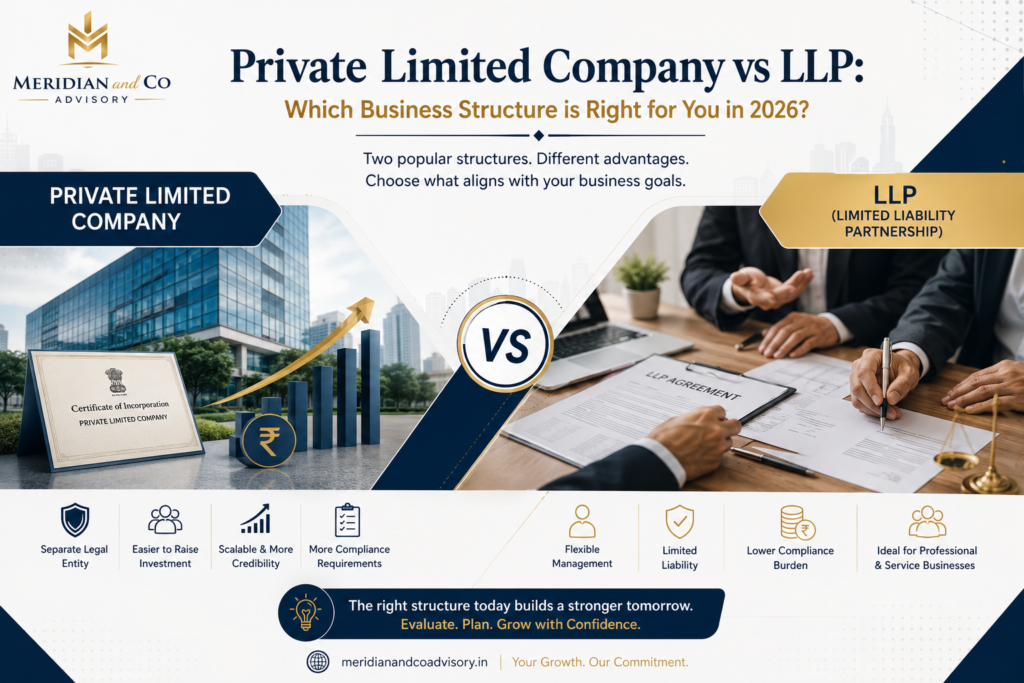
What is a Private Limited Company?
Private Limited Company is a separate legal entity. It is registered under the Companies Act, 2013 and regulated by the Ministry of Corporate Affairs (MCA).
Key Features:
-
- The minimum number of Directors should be 2 and Shareholders should be 2.
-
- The maximum number of Shareholders should be 200.
-
- The liability of Shareholders is limited.
-
- Separate legal identity from its owners
-
- Can raise equity capital from investors
A Pvt Ltd company is the go-to structure for startups and growth- oriented businesses. Most angel investors and venture capital firms prefer to invest in a Pvt Ltd company.
If you are looking at company registration in Bangalore or any other city, a private limited company is often the first recommendation for tech startups and product businesses.
What is an LLP?
An LLP stands for Limited Liability Partnership. It is governed by the Limited Liability Partnership Act, 2008.
Key Features:
-
- Minimum 2 designated partners
-
- No cap on the number of partners
-
- Partners have limited liability
-
- Separate legal entity
-
- Lower compliance burden than a Pvt Ltd
LLPs have both the benefits of a partnership and limited liability. It is a well regarded enterprise structure by consultancies, professional practices, and small businesses with stable revenues. LLP registration is typically chosen by law firms, architecture firms, chartered accountancy firms, and other similar outfits seeking a regulated place of business without as much governance compliance as a corporation.
Comparison of Private Limited Company vs LLP India.
Here is a clear comparison of the two structures across the most important parameters.
-
- Governance and Compliance
| Private Limited Company | LLP |
| Complying to the norms of the Companies Act, 2013 | Complying with the provisions of LLP Act, 2008 |
| Mandatory annual filings with the Registrar of Companies (AOC-4, MGT-7) | Fewer annual filings (Form 8 and Form 11) |
| Must hold Annual General Meetings (AGMs) | No mandatory AGMs |
| Board resolutions required for key decisions | Decisions governed by the LLP Agreement |
| Statutory audit mandatory regardless of turnover | Audit conducted only if turnover is more than Rs.40 lakh or contribution exceeds Rs.25 lakh. |
Verdict: LLP scores better on compliance as it requires lesser documentation and lesser expense.
-
- Liability Protection
Both structures offer limited liability. This means your personal assets are protected if the business faces a loss or legal claim.
However, there are exceptions:
-
- In a Pvt Ltd, directors can be held personally liable for fraud or negligence.
-
- In an LLP, partners are protected unless they are personally negligent or commit fraud.
Verdict: Both are equally strong on liability protection for standard business operations.
-
- Taxation
| Private Limited Company | LLP |
| Corporate tax: 22% (existing companies) or 15% (new manufacturing companies under Section 115BAB) | Flat 30% on total income |
| Dividend Distribution Tax abolished; dividends taxed in shareholders’ hands | Profit distribution to partners is tax-free |
| Subject to Minimum Alternate Tax (MAT) | Subject to Alternate Minimum Tax (AMT) at 18.5% |
Verdict: For businesses with high profits that are reinvested, a Pvt Ltd may offer a tax advantage. For businesses that distribute profits regularly, an LLP can be more tax efficient.
-
- Raising Funds and Investment
This is one of the biggest differences between a private limited vs LLP.
A Private Limited Company company can:
-
- Issue equity shares to investors
-
- Raise funds from angel investors and VCs
-
- Issue ESOPs to employees
-
- Convert into a public limited company later
An Limited Liability Partnership cannot:
-
- Issue equity shares
-
- Accept investment from most institutional investors
-
- Offer ESOPs easily
Verdict: If fundraising is part of your plan, a Pvt Ltd is the only real option.
-
- Ease of Transfer and Exit
Private Limited Company
-
- Shares can be transferred (subject to Articles of Association)
-
- Easier to bring in or remove stakeholders
-
- Business can be sold more easily
Limited Liability Partnership
-
- Partner’s interest can be transferred only with consent of other partners
-
- Slightly more complex to exit
Verdict: Pvt Ltd is more flexible for ownership changes.
-
- Cost of Formation and Maintenance
Limited Liability Partnership Registration
-
- Government fees are lower
-
- Registration process is straightforward
-
- Annual compliance cost is lower (8000-20,000 per year approximately)
Private Limited Company
-
- Government fees are slightly higher
-
- Annual compliance costs are higher (25000-50,000+ depending on complexity)
Verdict: LLP is more affordable for small businesses and professionals.
-
- Foreign Investment
Private Limited Company
-
- Can receive FDI (Foreign Direct Investment) under the automatic route in most sectors
Limited Liability Partnership
-
- Can receive FDI, but requires government approval in many cases
-
- Less investor-friendly for foreign capital
Verdict: Pvt Ltd is the preferred structure if you expect foreign investment

What Business Structure is Right for You?
Before you meet with your consultant, use this quick gut check; it’s not exhaustive, but it gives a good idea where you could be heading.
| If your priority is | Best fit |
| Securing equity funding from angels/venture capitalists | Private Limited Company |
| Minimizing compliance cost | Limited Liability Partnership |
| Distributing profits to partners in a tax-efficient mannerLimited Liability Partnership | Limited Liability Partnership |
| Receiving foreign direct investment without hassle | Private Limited Company |
| Operating a professional services business (legal, accounting, consulting, architecture) | Limited Liability Partnership |
| Looking at going public/selling your business later on | Private Limited Company |
| Having 5 or fewer partners with no need for external capital | Limited Liability Partnership |
Know which structure fits? Let’s make it official. Whether it’s a Private Limited Company or an LLP, we’ll handle the registration, paperwork, and compliance setup, so you can focus on building. Book Call Now
Who Should Choose a Private Limited Company?
A Pvt Ltd works best for:
-
- Startups planning to raise funding
-
- Business with growth and scale ambitions
-
- Companies expecting FDI
-
- Business with multiple employees where ESOPs matter
-
- Founders who want a credible, investment- ready structure
If you are in South India and searching for a firm registration option in Bangalore, then a Pvt Ltd option will suit your tech, SaaS, e-commerce, or any developing company needs.
Who are Eligible Candidates for Limited Liability Partnership?
An LLP is the best option for:
-
- Professional service firms such as law firms, consulting firms, and financial advisory firms.
-
- Companies with 2 to 5 partners with a steady earning stream who wish to share profits regularly.
-
- Small and medium enterprises with steady revenue
-
- Businesses that do not plan to raise equity
-
- Founders who want lower compliance costs
LLP registration is especially popular among legal and accounting professionals. It gives them the credibility of a formal structure without heavy compliance obligations.
Is an OPC the Right Choice?
You may have also heard of an OPC- One Person Company. It is a viable choice in case you are the sole owner of a company and want the advantages of the company format without having a partner.
The popularity of registering an OPC in Bangalore has been rising among freelancers, independent consultants and small business proprietors.
Key features of an OPC:
-
- Just one shareholder and one director should be there which can be the same person as well
-
- Limited liability
-
- Separate legal identity
-
- If there is a turnover of more than 2 crore INR or if there is said paid-up capital of more than 50 lakh INR then conversion to Pvt Ltd is mandatory (as per the old criteria; check the updated ones with MCA)
-
- Cannot raise external equity investment
If you are a solo founder and not planning to raise funds, OPC registration in Bangalore is worth exploring before you decide between a Pvt Ltd and LLP.
What are the Key Compliances After Registration?
Regardless of which structure you choose, there are ongoing obligations.
For Private Limited Company:
-
- Submit the AOC-4, which is the financial statements, and the MGT-7, which is the annual return, each year
-
- Conduct a minimum of 4 board meetings per year
-
- Keep statutory registers
-
- Get accounts audited annually
-
- File income tax returns
For Limited Liability Partnership:
-
- File Form 8 (Statement of Account & Solvency) by October 30
-
- File Form 11 (Annual Return) by May 30
-
- File Income tax returns
-
- Get accounts audited if turnover/contribution thresholds are met
Non -compliance attracts heavy penalties. For LLPs, the penalty can be rupees 100 per day per default. For companies, the penalties are even stricter under the Companies Act.

What Mistakes Should You Avoid When Registering Your Business?
-
- Choosing LLP for a funding-stage startup: If you plan to pitch to investors, register as a Pvt Ltd from day one. Converting an LLP to a Pvt Ltd is possible but time-consuming and involves additional costs.
-
- Ignoring compliance after registration: Many founders focus only on the registration. Annual filings and board meetings are equally important. Missed filings lead to penalties and can affect your company’s active status.
-
- Not drafting a strong LLP Agreement or SHA: For an LLP, your LLP Agreement is the backbone of the business. For a Pvt Ltd, a Shareholder’s Agreement (SHA) protects everyone’s interests. We’ve seen founder disputes get significantly harder to resolve when this document was an afterthought. Do not skip these.
-
- Choosing structure based only on cost: Yes, an LLP is cheaper to maintain. But if your business model requires equity funding, the lower cost of an LLP becomes irrelevant.
When Should You Convert Your Business Structure?
Conversion is possible but comes with costs.
-
- LLP to Pvt Ltd: Permitted under the Companies Act but requires stamp duty and legal fees
-
- OPC to Pvt Ltd: Straightforward if triggered by the statutory thresholds
-
- Convert Pvt Ltd to LLP: As permitted by Section 366 of the Companies Act; tax repercussions come into effect
It is advisable to select the right form of organization at the start instead of transforming afterwards.

2026 Updates to Keep in Mind
In 2025, a few developments are worth noting:
-
- The MCA has been pushing for faster LLP registration and company registration timelines under its V3 portal.
-
- The Centre for Processing Accelerated Corporate Exit(C-PACE) has made voluntary strike-offs faster for companies and LLPs
-
- While compliance calendars still have a degree of resemblance across both entities, it is important to recognize that digital filing is now mandatory.
If you intend to register your business this year, please ensure to keep abreast of MCA updates, as they periodically revise its compliance threshold, fees, and timelines.
Frequently Asked Questions
-
- Can I convert my LLP into a private limited company later?
Yes. According to the Companies Act, an LLP can be converted into a private limited company, although this requires additional documentation, stamp taxes, and legal costs. While this process is certainly doable, it is almost never as easy or economical as making sure the arrangement is correct from the start.
-
- Which structure is cheaper to maintain- Pvt Ltd or LLP?
An LLP is generally cheaper to maintain due to fewer mandatory filings and no requirement for statutory audits below certain thresholds. A Pvt Ltd carries higher annual compliance costs because of mandatory audits, AGMs, and board resolution requirements.
-
- Can an LLP raise funding from investors?
An LLP cannot issue equity shares, which makes it unsuitable for institutional or venture capital funding. If raising external equity is part of your roadmap, a private limited company is the structure built for that purpose.
-
- Is a private limited company always better than an LLP?
No – “better” depends entirely on your business goals. A Pvt Ltd is better suited to funding and scale; an LLP is better suited to professional services and steady income businesses that want lower compliance and tax-free profit distribution.
-
- Do I need a lawyer to register a Pvt Ltd or LLP?
It isn’t a strict legal requirement, but professional guidance materially reduces the risk of structuring mistakes that are expensive to undo later – particularly around shareholder agreements, ESOP pools, and FEMA compliance if foreign investment is involved.
-
- How long does company or LLP registration take in India?
With the MCA’s V3 portal, both registrations are faster than they used to be, though actual timelines depend on document readiness, name approval, and DSC/DIN processing. It’s worth budgeting a few weeks rather than assuming same-week turnaround.
Conclusion
The private limited v LLP decision is not one-size fits all. Both are credible, legally sound structures. The right choice depends on your business model, growth plan, and compliance appetite.
-
- Choose a Pvt Ltd if you want to raise funds, scale fast, or operate in a sector that requires formal corporate governance.
-
- Choose an LLP if you are a professional service provider, want lower compliance costs, and plan to distribute profits regularly.
-
- If you are a solo founder, explore OPC registration in Bangalore before deciding.
Whether you need LLP registration, company registration or advice on pvt ltd vs LLP India, getting early legal guidance saves you from costly mistakes down the line.


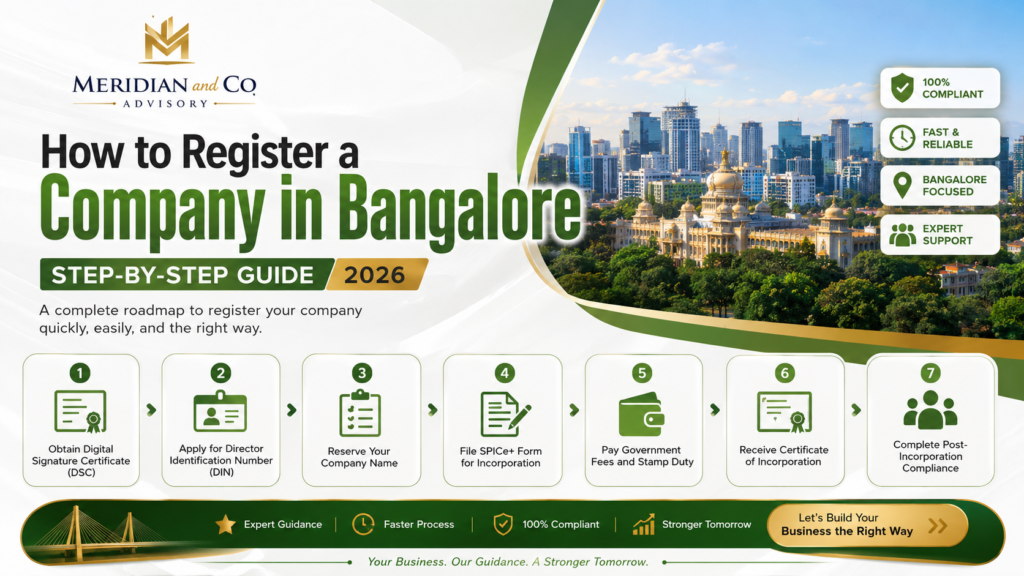

Pingback: Company Founders Agreement: What It Is and Why Every Bangalore Startup Needs One Before Day One - Meridian & Co. Advsisory