Before You Begin: Choose the Right Business Structure
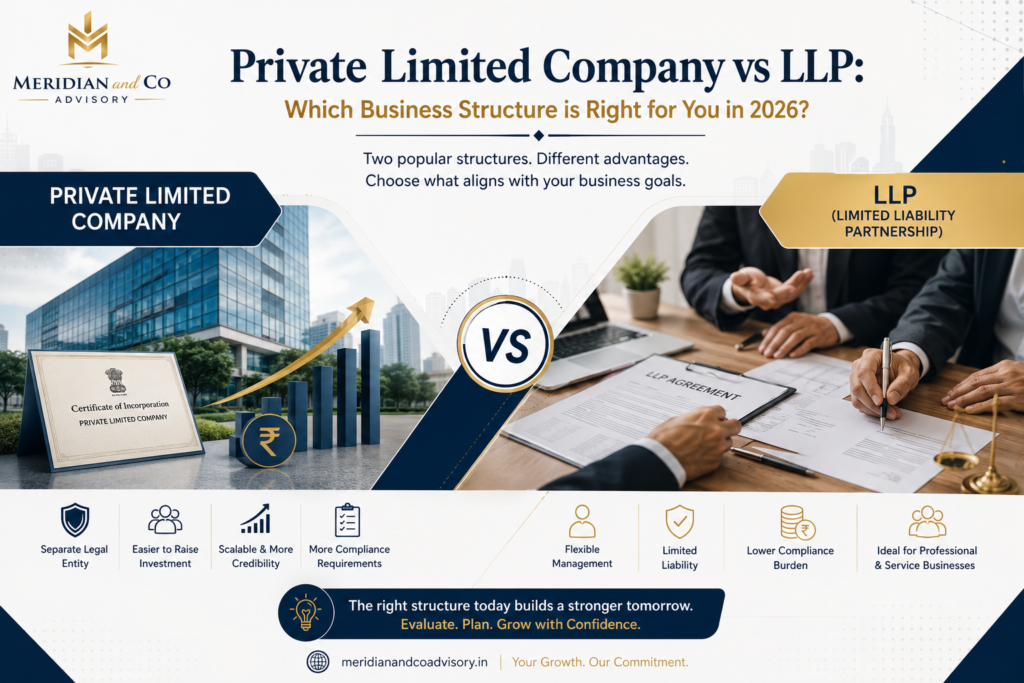
Many online guides do not include this information, but this is one step that new business owners tend to get wrong. Your business structure determines not only how your business will raise money, how profits will be distributed, and what types of liabilities the owner will have, but also how future investors view your business.
The three structures most commonly linked with registration process in Bangalore:
Bangalore Private Limited Company Registration
Best suited for those who want to get funds or to find partners in business and are planning further development. It limits the liability of persons, as well as gives the opportunity to attract investors by means of issuing shares. Its registration requires at least 2 directors and 2 shareholders. The private limited company is a widely spread form of doing business among young entrepreneurs
Bangalore One Person Company Registration
It is designed for entrepreneurs who do not want to bother about finding partners and want to have their own business protected from liabilities. Ideal for freelancers, consultants and young entrepreneurs who are registering their company for the first time. Over the years, the popularity of OPC has been growing because more individual entrepreneurs are moving from the ownership business to the legal one.
LLP Registration in Bangalore
A hybrid structure with lower compliance obligations than a Pvt Ltd. Some professional service firms, small consulting firms, and organizations in which the partners share the profit may prefer this structure. It is not suitable for newer ventures that will seek institutional funding.
Have you figured out how to structure your organization? If not you would benefit from our consultation on business structuring service.

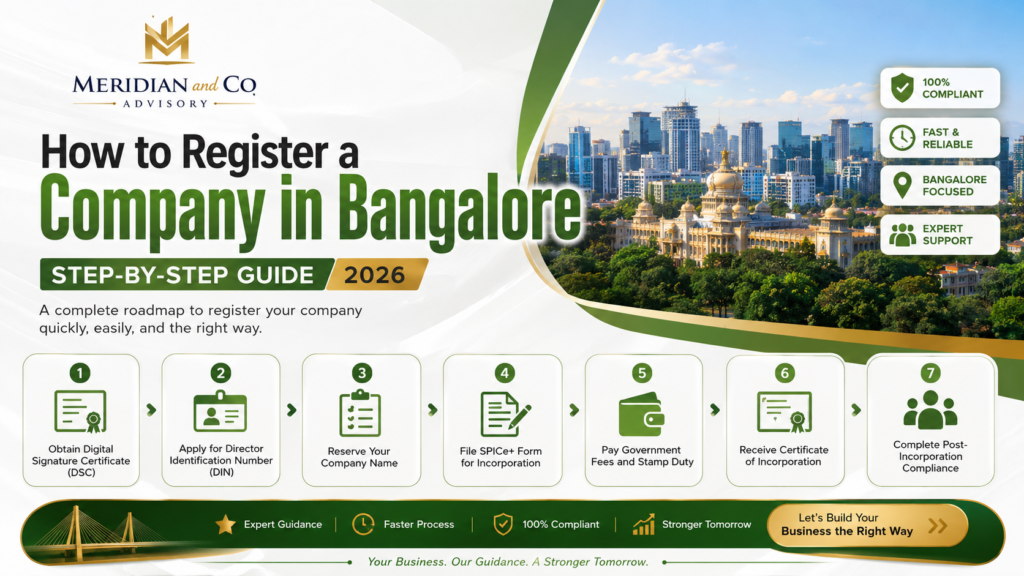
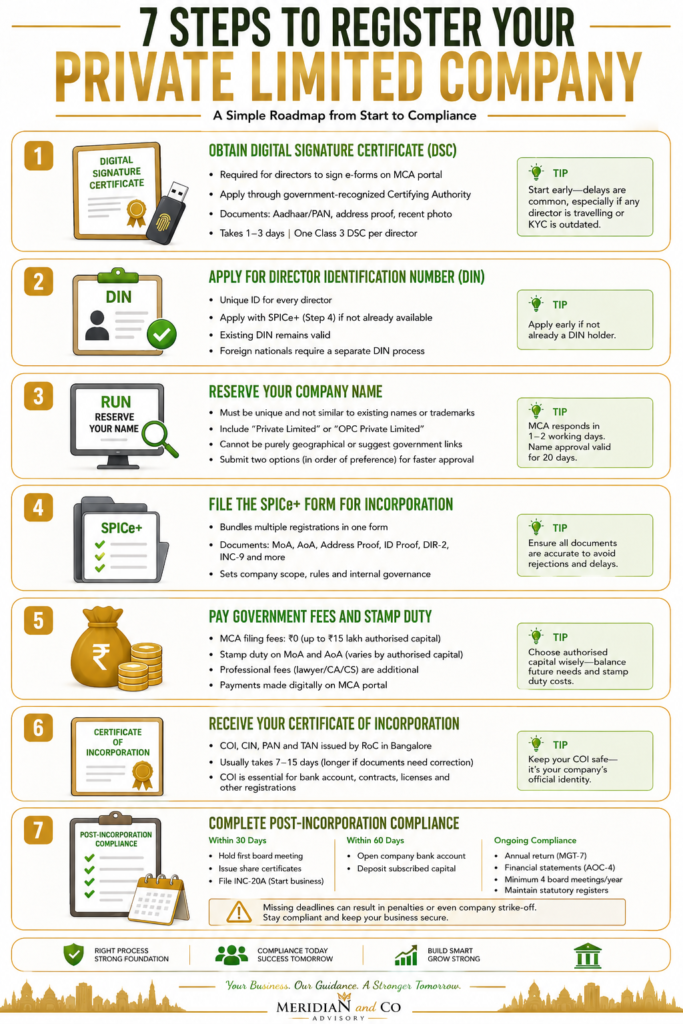
Step 1: Obtain a Digital Signature Certificate (DSC)
Every director who is proposed must possess a Digital Signature Certificate, as it is a prerequisite before any filings can be made in the MCA portal. The DSC ensures that all e-forms are verified online, failing which the process cannot commence.
The procedure for obtaining the DSC is to apply through a Certifying Authority recognized by the government. Proof of identity (Aadhaar or PAN) and Proof of address along with a photograph must be presented. The process takes 1–3 days.
What you need: One Class 3 DSC per director. For a standard Pvt Ltd with two directors, that means two certificates.
In practice, this step causes more delays than founders expect, mostly because one of the proposed directors is travelling, or they have KYC that is already outdated with their Certifying Authority. Start it early, and don’t wait, especially if your co-founder is not based in Bangalore.
Step 2: Apply for a Director Identification Number (DIN)
Every proposed director needs a Director Identification Number, a permanent unique identifier issued by the MCA. If you are forming a corporation for the first time, you can apply for a Director Identification Number (DIN) along with your SPICe+ paperwork (Step 4), thus there is no need for an additional process.
Do you already have a DIN from a previous directorship? It remains valid, no need to reapply.
Appointing a foreign national as director? A separate DIN application process applies before the SPICe+ filing.
Step 3: Reserve Your Company Name
Prior to submitting any paperwork for incorporation, you must reserve your preferred name with the Ministry of Corporate Affairs using the RUN (Reserve Unique Name) feature or the SPICe+ application.
Rules your name must meet:
- Your proposed name must be different from existing registered name of any other company or the name of existing live trademark
- The name has to contain the phrase “Private Limited” (Pvt Ltd) or “OPC Private Limited” for One Person Companies
- The name cannot be purely geographical or generic nor suggest government relation
How to improve approval chances: Provide two name options in order of priority. MCA usually responds in 1-2 working days so in case both names have been rejected, you can provide the new names
Be advised that name approval is valid only for 20 days: you have to submit your full SPICe+ incorporation application within that timeframe
A common misconception: names that are very close to famous brands, even with minor spelling differences, get rejected regularly. Hiring a lawyer who understands the naming conventions of the MCA can point to the possible problems in name selection before you apply.
One pattern worth knowing: names too close to well-known brands, even with minor spelling variations, are regularly rejected. A corporate lawyer familiar with MCA naming conventions can flag these risks before you submit and save a round of rejections.
Step 4: File the SPICe+ Form for Incorporation
The SPICe+ (Simplified Proforma for Incorporating Company Electronically Plus) is the central filing through which company registration in Bangalore, and across India, is completed. It bundles multiple registrations into a single submission:
Company incorporation
-
- DIN allotment (if not already held)
- PAN and TAN for the company
- GST registration (optional at this stage)
- EPFO and ESIC registration
- Bank account opening (for select partner banks)
Documents required for the filing:
-
- Memorandum of Association (MoA): specifies actions permitted to a company by the law
- Articles of Association (AoA): contain provisions for internal management, director powers, and rights of the shareholders
- Evidence of registered office in Bangalore (utility bill not older than 2 months + landlord NOC in case of rented office)
- Identity and address proof for all directors and shareholders
- Form DIR-2 (Consent to act as director) for each director
- Form INC-9 (Declaration of compliance)
The MoA and AoA deserve more attention than most founders give them. The MoA’s objects clause defines the legal scope of your business, if it’s too narrow, you may need an amendment the moment you expand your product or service. The AoA governs how decisions are made, how shares are transferred, and how disputes between founders are handled. These aren’t standard templates to fill in quickly; they’re the founding documents your company will operate under.
Karnataka’s registered office address requirements also have specific documentary standards: address proof from Bangalore is required, and the NOC from the property owner must be on record. Our company registration service reviews this documentation before filing to avoid a rejection and resubmission cycle.
Step 5: Pay Government Fees and Stamp Duty
MCA filing fees are calculated based on the authorised share capital of the proposed company. Under the current MCA fee schedule, companies with authorised capital up to ₹15 lakh pay zero MCA filing fees. Stamp duty on the MoA and AoA is a separate charge and follows Karnataka’s stamp duty schedule.
Approximate costs for a standard early-stage Pvt Ltd:
- MCA filing fees: ₹0 (up to ₹15L authorised capital)
- Stamp duty on MoA: Typically ₹1,000-₹5,000 depending on authorised capital
- Professional fees (lawyer, CA, or CS): Charged separately
All payments are made digitally through the MCA portal. No physical submission is required for standard incorporations.
Do you know what authorised capital to choose? Setting it too low creates friction when you need to issue shares to an investor. Setting it too high increases stamp duty. Getting this calibrated to your actual needs is one of the small decisions that makes a meaningful difference.
Step 6: Receive Your Certificate of Incorporation
After the SPICe+ submissions are approved by the RoC in Bangalore, you shall receive:
-
- Certificate of Incorporation (COI)- the document that makes your company legally operational.
- Corporate Identity Number (CIN) – your company’s identifier with the MCA.
- PAN and TAN of the company (issued concurrently along with the COI).
Usually takes about 7 to 15 days but if the documents are incomplete then resubmission takes much longer, anywhere between 7 to 10 more days.
The COI is the most important document that you will require after this, especially for opening your bank account, entering contracts, applying for the required licenses, onboarding clients, and in case you wish to get MSME registration in Bangalore.
Step 7: Complete Post-Incorporation Compliance
Incorporation is not the finish line , and mandatory steps have to be completed in certain timeframes after the COI is issued. This is where a lot of first-time founders get hit with penalties , not because they messed up anything during the registration process, but because they miss the post-incorporation window , kind of straightforward but still easy to overlook.
Within 30 days of incorporation:
- Hold the first board meeting
- Issue share certificates to all shareholders
File Form INC-20A (Declaration of Commencement of Business) under Section 10A of the Companies Act, 2013, your company cannot legally start any business operations until this form is filed and accepted
Within 60 days of incorporation:
- Open a current account in the company’s name.
- Deposit the subscribed share capital into the company’s bank account
Ongoing annual compliance:
- Annual return: Form MGT-7 (filed with RoC)
- Financial statements: Form AOC-4 (filed with MCA)
- Minimum 4 board meetings per year
- Maintenance of statutory registers: Register of Directors, Register of Members, and others
If INC-20A isn’t filed within 180 days of incorporation , penalties apply and in some cases the company can be struck off the register. For annual compliance lapses, compounding penalties can be triggered under the Companies Act, 2013. These are not just procedural steps or routine box-ticking, they’re legal duties with real financial impact.
A Note on Professional Guidance
The MCA portal allows self-filing. But registering a company in Bangalore involves decisions, about structure, about the MoA’s objects clause, about share capital, about AoA provisions, that live well beyond the form itself.
A corporate lawyer with a postgraduate specialisation in commercial law (LL.M.) approaches these filings differently from a platform that automates paperwork. The questions asked before drafting, about funding plans, co-founder exits, future product lines, shape documents that hold up when it matters most.
This doesn’t mean every founder needs full-service legal support for a straightforward OPC. It means the cost of getting incorporation right is almost always lower than the cost of correcting it later. If you’d rather have a lawyer run the filing end-to-end, our Business Structuring Services page walks through how that works.
Company Registration in Bangalore: Summary at a Glance
| Step | Action | Timeline |
| 1 | Obtain DSC for all directors | 1-3 working days |
| 2 | Apply for / confirm DIN | Included in SPICe+ |
| 3 | Reserve company name (RUN) | 1-2 working days |
| 4 | File SPICe+ with MoA, AoA, all documents | Once name is approved |
| 5 | Pay MCA fees and Karnataka stamp duty | At time of SPICe+ filing |
| 6 | Receive Certificate of Incorporation from RoC, Bangalore | 7-15 working days |
| 7 | File INC-20A + open bank account + issue share certificates | Within 30-60 days of COI |
Frequently Asked Questions
-
- How long does company registration in Bangalore usually take?
If all your documents are in order and there are no objections from the Ministry of Corporate Affairs (MCA), company registration in Bangalore typically takes 7–15 working days. However, delays can happen if your proposed company name is rejected or your incorporation documents require corrections. Preparing everything correctly the first time can significantly speed up the process.
-
- What is the cost of registering a company in Bangalore?
The overall cost depends on several factors, including your business structure, authorised share capital, professional fees, and applicable stamp duty. While companies with authorised capital up to ₹15 lakh currently pay no MCA filing fee, you’ll still need to account for stamp duty and professional assistance if you choose to work with a lawyer or consultant.
-
- Can I register a company in Bangalore completely online?
Yes. The company registration process is largely online through the MCA portal. Applications, document submissions, and fee payments are all completed electronically. The only offline requirement is ensuring you have the necessary supporting documents and identity proofs ready before filing.
-
- Which business structure should I choose, Private Limited Company, LLP, or OPC?
It depends on your business goals.
- A Private Limited Company is usually the best choice if you plan to raise investment or grow your business.
- An LLP works well for professional firms and businesses with multiple partners looking for simpler compliance.
- An One Person Company (OPC) is suitable for solo entrepreneurs who want limited liability without bringing in partners.
Choosing the right structure early can save you from costly changes later.
-
- Is a registered office in Bangalore mandatory?
Yes. Every company must provide a registered office address while applying for incorporation. If you’re operating from a rented property, you’ll generally need a recent utility bill and a No Objection Certificate (NOC) from the property owner.
-
- What documents are required for company registration?
The exact list varies slightly depending on the type of company, but you’ll generally need:
- PAN and Aadhaar of directors
- Address proof of directors
- Passport-size photographs
- Registered office address proof
- Utility bill (not older than two months)
- Rental agreement and landlord’s NOC (if applicable)
Additional incorporation documents like the Memorandum of Association (MoA) and Articles of Association (AoA) are also required during the filing process.
-
- Do I need a Digital Signature Certificate (DSC) before applying?
Yes. Every proposed director must have a valid Digital Signature Certificate (DSC) before incorporation documents can be filed with the MCA. Since obtaining a DSC may take a few days, it’s a good idea to start this process early.
-
- What happens if my proposed company name is rejected?
A rejected company name doesn’t mean your application has failed. You can submit a new name for approval. To reduce the chances of rejection, choose a name that’s unique, doesn’t closely resemble an existing company or trademark, and complies with MCA naming guidelines.
-
- Can I register a company without visiting any government office?
In most cases, yes. The incorporation process is designed to be completed online, and most founders don’t need to visit any government office. As long as your documents are properly prepared and digitally signed, the entire process can usually be completed remotely.
-
- Is GST registration compulsory during company registration?
Not always. GST registration is mandatory only if your business meets the eligibility criteria under GST law, such as crossing the prescribed turnover threshold or operating in businesses where GST registration is compulsory. Many startups choose to apply for GST during incorporation for convenience, but it’s not mandatory for every company.
-
- What should I do after receiving the Certificate of Incorporation?
Getting your Certificate of Incorporation is just the beginning. After incorporation, you should:
- Open the company’s bank account
- Deposit the subscribed share capital
- Hold the first board meeting
- Issue share certificates
- File Form INC-20A (where applicable)
- Begin maintaining statutory records and annual compliances
Missing these post-incorporation requirements can lead to penalties.
-
- Can I register a company myself, or should I hire a professional?
The MCA portal allows founders to complete the registration process themselves. However, incorporation isn’t just about submitting forms, it’s also about making decisions that affect your business in the long run, such as choosing the right business structure, drafting the MoA and AoA, and planning your shareholding. If you’re unsure about these aspects or expect future investors, seeking professional guidance can help you avoid costly mistakes.