Why FSSAI Registration Is Non-Negotiable for F&B Businesses in Bangalore
According to the Food Safety and Standards Act of 2006, the Food Safety and Standards Authority of India (FSSAI) was formed.
A business involved in producing food, processing it, storing, distributing, and selling it is required to obtain FSSAI registration or license.
The FSSAI number serves more than just a purpose of legal compliance for business.
- Zomato, Swiggy, and ONDC all ask for a valid FSSAI number to onboard.
- Clients from institutions, corporate entities, or schools need an FSSAI Number before they award contracts for catering.
- BBMP inspections and municipal health checks verify FSSAI status.
- Violation of the FSS Act, 2006 could lead to considerable penalties for food business operations..
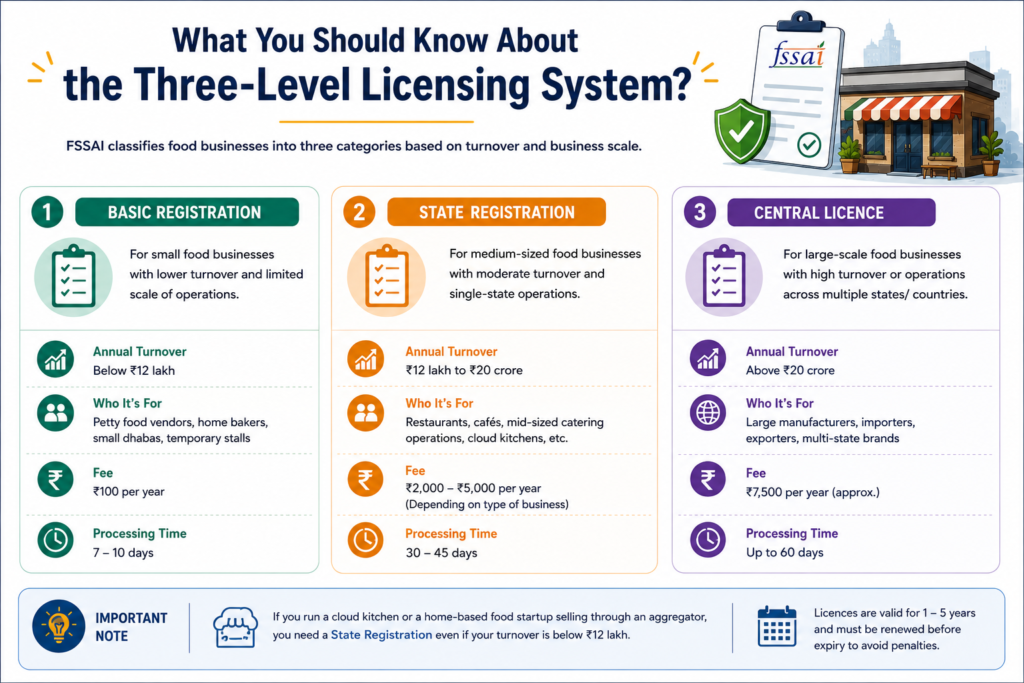
What You Should Know About the Three-Level Licensing System?
FSSAI classifies food establishments into three groups. Many businesses make the mistake of choosing the wrong level which leads to delays and compliance issues.
Basic Registration (Form A)
Annual turnover below ₹12 lakh. Petty food vendors, home bakers, small dhabas and temporary stalls fall under this category, with an annual fee of ₹100 per year. Processing time is up to 7–10 days.
State Registration (Form B)
Turnover between ₹12 lakh and ₹20 crore. Most restaurants, cafés, mid-sized catering operations, and cloud kitchens fall here, with an annual fee of ₹2,000–5,000 depending on the type of business. Processing time is up to 30–45 days.
Central Licence (Form B)
Turnover above ₹20 crore, or businesses operating across multiple states, importers and exporters must get this licence. It costs around ₹7,500 per year and takes up to 60 days to process.
Note: if you run a cloud kitchen or a home-based food startup selling through an aggregator, you need a State Licence even if your turnover is below ₹12 lakh. This is a 2025-onward regulatory position that many operators miss.
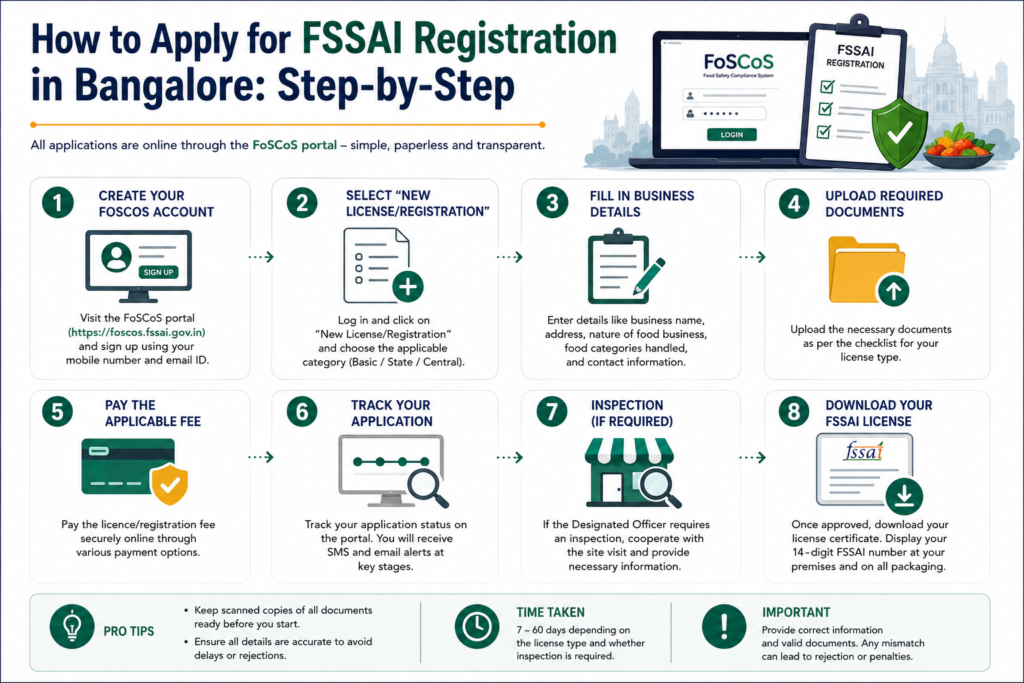
How to Apply for FSSAI Registration in Bangalore: Step-by-Step
All FSSAI applications are processed through the FoSCoS portal. There are no offline counters for new applications.
- Create a login on the FoSCoS portal using your mobile number and email.
- Select “New License/Registration” and choose the applicable category.
- Fill in business details: name, address, nature of food business, food categories handled.
- Upload the required documents (see checklist below).
- Pay the applicable fee online.
- Track your application status via the portal, you’ll receive SMS and email alerts at each stage.
- If the Designated Officer requires an inspection, cooperate with the site visit.
- Download the licence certificate once approved display your 14-digit FSSAI number at your premises and print it on all packaging.
Documents Required for FSSAI Registration in Bangalore
- Photo ID: Aadhaar card, PAN, passport-size photo of the applicant/authorised signatory.
- Address proof for the premises: rent agreement or property tax receipt.
- Business registration proof: MCA certificate for Pvt Ltd/LLP, Partnership Deed, or GST certificate for others.
- List of food categories.
- Food Safety Management Plan: required for State and Central Licence; not mandatory for Basic Registration.
- Layout plan of premises (for State and Central Licence) showing processing area, storage, and sanitation.
- NOC from the owner, if the premises is rented.
- Water test report, if using a private water source.
- Import/Export Code, only if applying for a Central Licence for import/export.
FSSAI Licence Validity and Renewal
FSSAI licences and registrations can be obtained for a period of 1 to 5 years. Longer validity reduces renewal frequency and total administrative burden.
- In case of renewal unfulfilled before expiration, a new application must be submitted instead of simply paying the renewal fee.
- If renewal is performed late, penalties will apply and onboarding status of the aggregator can be impacted (Swiggy/Zomato conducts regular checks of FSSAI validity).
- Under 2025–2026 regulations, State Licence holders are required to file annual returns through the FoSCoS portal.
- Modification of any detail on the licence (address, food categories, business name) requires a modification application with a fee equivalent to one year’s licence fee.
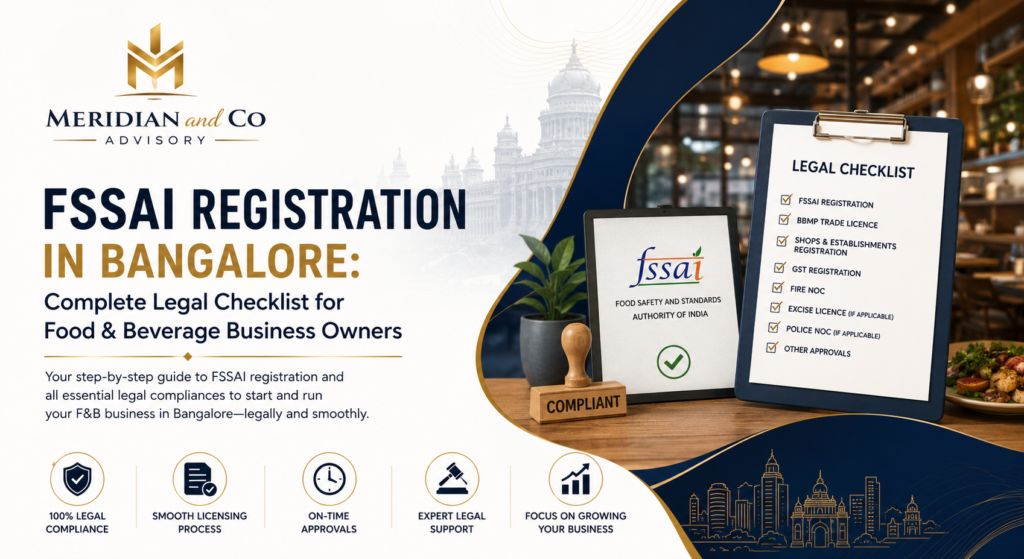
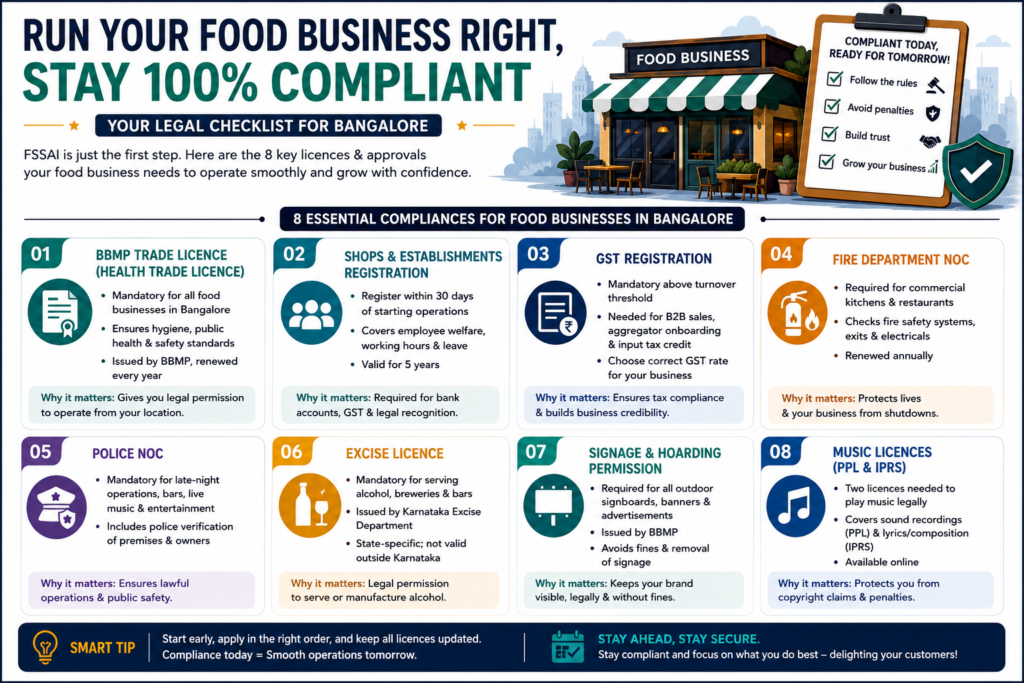
Beyond FSSAI: The Complete Food Business Legal Compliance Checklist for Bangalore
FSSAI registration is the first licence you should secure, but it’s rarely the last. Here is the complete compliance framework for food and beverage businesses under Karnataka and central law.
1. BBMP Trade Licence (Health Trade Licence) in Bangalore
Issuing authority: BBMP
Applicable Law: Karnataka Municipal Corporations Act, 1976 (Schedule X)
Every Business dealing in Food and Beverages, from restaurants, cafes, bakeries, and cloud kitchens to catering and food trucks, requires a BBMP Health Trade License, Type A – a separate license and not the same as FSSAI license.
Documents required:
- Complete application form
- Owner’s Aadhaar/PAN
- Rent agreement or property tax receipt
- Passport-size photograph
- FSSAI registration certificate
- Fire Department NOC (for restaurants)
- Self-declaration regarding the hygiene and health standards
Apply online through the BBMP e-governance portal. The license is valid for a year and needs to be renewed every year. The approval process usually takes about 7-15 business days after the paperwork is completed.
The BBMP Health Trade License should not be mistaken for a regular trade license. The license is applicable only to food applications falling under Type A (food / health establishments) prescribed under Schedule X of the KMC Act. If the wrong type is used, acceptance of the application may take time.
2. Registration with Shops and Establishments
Governing law: Karnataka Shops and Establishments Act, 1961
Portal: e-Karmika
All businesses in Karnataka, including food businesses, need to be registered under the Shops and Establishments Act. Registration must be done within 30 days of the commencement of operations, failing which the business might face penalties. The registration certificate remains valid for 5 years and must be displayed in a conspicuous manner inside the establishment.
Registration under this law regulates matters concerning working conditions; working hours; leave; wages and is mandatory for opening a bank account, acquiring GST registration and qualifying for government contracts.
3. GST Registration
As per law, registration on the GST portal is compulsory for all food businesses whose annual turnover exceeds ₹20 lakh in the general category and ₹10 lakh in special category states. However, even if the turnover is below the prescribed limit of ₹20 lakh, registration is suggested if you are supplying goods to clients registered under GST, or if you are active on food aggregators like Zomato/Swiggy or you are bidding on government catering contracts.
- Restaurant services are liable for a GST rate of 5% unless input tax credit (ITC) is allowed.
- In case the food business is operated in a hotel having room tariffs of more than ₹7,500 per night, GST rate of 18% will be applicable.
- Packaged food products and takeaway may attract different rates depending on HSN classification.
- Cloud kitchens are treated as restaurants for GST purposes.
4. Fire Department NOC
Any commercial kitchen, hotel or eatery with a specific area is required to obtain NOC from State Fire & Emergency Dept. of Karnataka.
- Submit the evidence to your local fire department.
- Physical examination of the fire extinguishers, exits, and electrical safety.
- NOC is renewed annually.
5. Police No Objection Certificate (NOC) conducive to Late Night Operations and Bars.
Any establishment operating after 11.00 PM, and all live music venues, bars, and entertainment activities need to obtain a Police No Objection Certificate from the local police station (jurisdictional commissioner’s office). The verification involves looking at the criminal history of the applicant and the place they apply from.
6. Excise License (for Bars, Restaurants with Alcohol, and Breweries)
Governing law: Karnataka Excise Act, 1965
India has liquor regulation under Entry 8 of the State List in the seventh Schedule of the Constitution. This means each state has its own excise policy and Karnataka excise license has no validity in other states.
7. Signage and Hoarding Permission
Any external display board, banner, or hoarding on your premises requires BBMP’s Outdoor Media Licence/Advertisement Tax Approval. Unauthorised hoardings are routinely removed during BBMP enforcement drives and attract spot fines.
8. Music License (PPL & IPRS)
If your establishment features music, whether it is from a streaming platform, a DJ, or a concert, you will need to obtain two distinct types of licenses:
- The Phonographic Performance Limited (PPL India) license: this license pertains to the licensed music itself
- The Indian Performing Right Society (IPRS) license: this license pertains to the music’s lyrics and composer.
In the absence of these licenses, one may face the wrath of copyright infringement as stated in the Copyright Act of 1957. Both licenses are available online via the websites of PPL India and IPRS.
The Right Order to Approach Your F&B Legal Setup in Bangalore
Licence applications filed in the wrong order cause delays some licences require others as a prerequisite document. Here is the sequence we follow at Meridian & Co:
- Register your entity first most other licences require your MCA certificate or business PAN.
- Apply for FSSAI registration this is the anchor licence; BBMP and aggregators will ask for it.
- Apply for Shops and Establishments registration on the same day there’s no reason to delay this.
- Apply for GST registration once your entity and FSSAI are in hand.
- Apply for the BBMP trade licence this will ask for your FSSAI number and may require a Fire NOC.
- Obtain the Fire NOC before or in parallel with the BBMP trade licence.
- Obtaining the Police NOC and excise licence last these take the longest to process and are the most jurisdiction-specific.
- Apply for PPL & IPRS licences once you know your seating capacity and music format.
Run applications in parallel wherever possible FSSAI, Shops and Establishments, and GST can all be filed simultaneously.
Common Legal Mistakes F&B Founders Make
1. Signing the Lease Before Securing Regulatory Clarity
We’ve seen founders lock in a 3-year lease on a commercial space, only to discover it falls in a zoning area that doesn’t permit the type of food service they intended, or that the property owner’s title has encumbrances that affect the BBMP application. A legal review before you sign a lease costs a fraction of what breaking a lease does.
2. Assuming FSSAI Basic Registration Is Sufficient
Many operators register under the Basic category because it’s cheaper and faster. If your turnover crosses ₹12 lakh, which most dine-in restaurants exceed quickly or if you’re listing on an aggregator, you need a State Licence. Operating on the incorrect FSSAI category is a compliance risk that surfaces during inspection.
3. Ignoring Music Licensing
This is the most overlooked compliance item in the café and bar scene. Copyright enforcement under PPL & IPRS is active in metro cities venues have faced legal notices and significant penalties for playing music without valid licences.
4. Skipping the Shareholders’ or LLP Agreement
If you’re co-founding an F&B business, your internal governance document matters as much as your external licences. We’ve seen co-founder disputes in restaurants that had perfect regulatory compliance but no written agreement on profit-sharing, exit rights, or operational roles. Our team can help you put a Shareholders’ or LLP Agreement in place before it becomes an afterthought.
Conclusion
Starting a food venture is truly thrilling because the demand for top-notch food, varied formats, and innovative ideas in the city is different from other markets in India. However, the regulatory procedures are more intensive than many entrepreneurs expect during their initial discussions with a business model. The entrepreneurs who master compliance are those who consider legal matters as part of their pre-opening timeline.
Work With Meridian & Co
At Meridian & Co, corporate law firm in Bangalore, we have been doing these processes regularly for start-up restaurant owners and for F&B companies which are expanding into several locations. If you are planning to open an F&B business in Bangalore, you can request our Compliance Consultants team to prepare the whole process of licensing and handle all paperwork, so you do not have to find out that something is missing two weeks before starting to operate.
Frequently Asked Questions
Do I need a separate FSSAI licence for each restaurant outlet?
Indeed, there is a need for FSSAI registration which is based on location. Each outlet has to have an individual licence. For instance, in case of an owner having a number of outlets in Bangalore, each outlet demands the availability of separate licence from FSSAI.
Can I sell food on Swiggy/Zomato with just a Basic Registration?
No. Aggregator platforms require a State Licence for cloud kitchens and delivery operations, regardless of turnover. This changed under 2025 regulatory updates. Apply for a State Licence from the outset if you plan to list on aggregator platforms.
Is a cloud kitchen regulated differently from a restaurant?
Cloud kitchens are regulated under the same legal framework but with some practical differences a State Licence is mandatory regardless of turnover, the Fire NOC requirement depends on premises size, and there’s no need for a Police NOC (unless operating late hours). All other licences BBMP, Shops Act, GST apply equally.