Why Do Banks, NBFCs and Vendors Require Corporate KYC?
The corporate KYC documents are mostly meant not for the banks and NBFCs to slow you down. They have to, under the KYC and anti-money laundering norms of the RBI, and they take on the compliance risk if they do not. When a vendor or corporate client asks for your paperwork, they are applying the same principle on a smaller scale, protecting themselves before extending credit, signing a contract or adding you to an approved supplier list.
This is also the reason why the documents are examined so closely. But, in fact, a missing signature or an out-of-date address proof is not just a nuisance: it represents regulatory compliance risk for the bank. The checklist begins to make a whole lot more sense when you get that the request is not arbitrary.
The part that gets tricky is that KYC documents for a company look different based on what type of entity you are. What is filed by a proprietorship is different from what is required for a private limited company. Here’s the complete breakdown by each.
Corporate KYC Documents Checklist: Quick Comparison Table
| Document / Information | Pvt Ltd | LLP | Partnership | Proprietorship |
| Incorporation / registration proof | Required | Required | If registered | N/A |
| PAN | Company PAN | LLP PAN | Firm PAN | Proprietor PAN |
| Constitutional document | MOA/AOA | LLP Agreement | Partnership Deed | N/A |
| Authorized signatory details | Required | Required | Required | Required |
| Ownership / beneficial ownership information | Where applicable | Where applicable | Where applicable | N/A |
| Registered/business address proof | Required | Required | Required | Required |
| GST / business registration | If applicable | If applicable | If applicable | Business proof |
| Financial documents | Depending on purpose | Depending on purpose | Depending on purpose | Depending on purpose |
A Common KYC Gap We See in Practice
One common pattern we observe during corporate KYC onboarding is that the companies have all required documents yet they do not hold that specific version of the document to validate for transactions.
So for example a board resolution may exist but it could relate to previous transaction, name a previous authorised signatory or simply not be worded in such a clear and precise manner as to adequately cover the transaction now being done. Thus, while the document exists, it fails to meet the specific KYC requirements for that transaction, rendering the file incomplete.
That is why we would suggest validating each document against three questions before submission:
- Is it current?
- Does it align with the company’s most recent official records?
- Does this explicitly authorize or provide consent for the specific transaction being carried out?
Updated Concluding Takeaway: Running this 3-step pre-submission check ensures every document is transaction-ready, eliminating back-and-forth delays and ensuring seamless first-time onboarding approval.
4 Core Details Corporate KYC Verifies
Corporate KYC is more than just verifying a company exists. Broadly speaking, the institution is attempting to do four things:
- Identity: Does the legal entity exist, and do its basic details match those in the submitted records?
- Ownership: Who ultimately owns or controls the thing?
- Authority: Who will have the right to act or transact on behalf of the company?
- Business profile: What is the nature of business and what else needs to be known before making a decision on the transaction or risk.
Which is why a corporate KYC file has both corporate documents at company level, with individual KYC documents for directors, partners, beneficial owners or authorized representatives.
For regulated entities, the requirements which apply to you are defined within the applicable KYC and customer due-diligence regulatory framework. In addition to common regulation and specific products and transactions, institution-specific requirements can also exist.
7 Points Corporate KYC Readiness Audit To Test Documentation
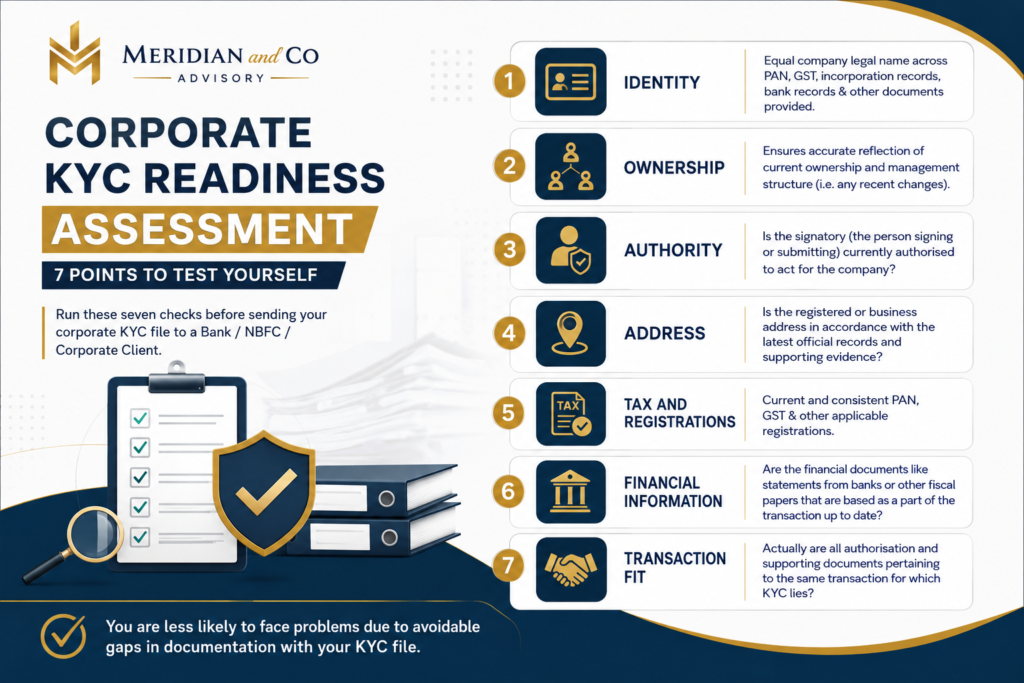
Here are Seven Checks you should run before sending a corporate KYC file to a Bank/NBFC/corporate client.
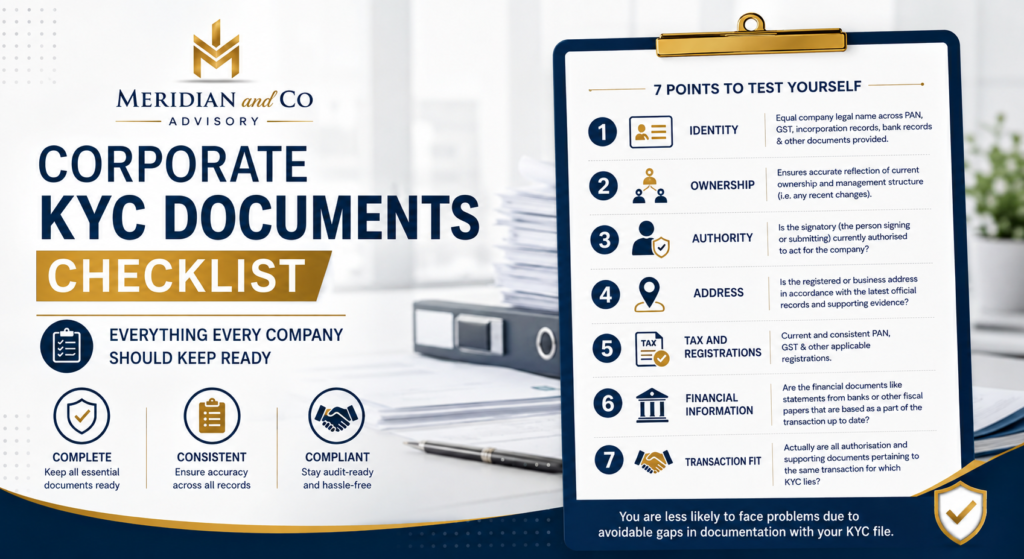
- Identity: Equal company legal name across PAN, GST, incorporation records, bank records & other documents provided.
- Ownership: Ensures accurate reflection of current ownership and management structure (i.e. any recent changes).
- Authority: Is the signatory (the person signing or submitting) currently authorised to act for the company?
- Address: Is the registered or business address in accordance with the latest official records and supporting evidence?
- Tax and registrations: Current and consistent PAN, GST & other applicable registrations
- Financial information: Are the financial documents like statements from banks or other fiscal papers that are based as a part of the transaction up to date?
- Transaction fit: Actually are all authorisation and supporting documents pertaining to the same transaction for which KYC lies?
You are less likely to face problems due to avoidable gaps in documentation with your KYC file.
Corporate KYC Documents Checklist for Private Limited (Pvt Ltd) Companies
Private limited companies are a common entity type for corporate KYC onboarding. They usually provide comprehensive company records along with details about directors, authorised signatories and where applicable, beneficial owners.
Statutory & Incorporation Documents
- Certificate of Incorporation issued by the Registrar of Companies (ROC)
- Memorandum of Association (MOA) and Articles of Association (AOA)
- Company PAN Card
- GST Registration Certificate (if applicable)
Signatory & Board Authorizations
- Specific Board Resolution authorizing the transaction and appointing designated signatories
- List of Current Directors with their Directors Identification Numbers (DIN) and PAN cards
Address & Financial Verification Proofs
- Proof of Registered Address (e.g., utility bill or lease/rent agreement not older than 3 months)
- Audited Financial Statements for the latest financial year (if requested by the bank or institution)
Each and every one of these performs a particular function. For instance, the board resolution specifies who within the company is allowed to represent it for that transaction, a general outdated resolution will not meet this requirement.
Ultimate Beneficial Ownership: The Critical KYC Requirement Most Miss
A bank or other regulated institution may need information and supporting documents regarding beneficial ownership and control depending on the entity and its ownership structure.
When Is Ultimate Beneficial Ownership (UBO) Verification Triggered?
UBO documentation and declaration are typically required under any of the following conditions:
- Multiple Shareholding Tiers: The company has multiple shareholders or multi-layered ownership structures.
- Transferred Ownership: Shares, equity, or voting control have passed from one party to another across various holding entities.
- Corporate Ownership: Shares are held or controlled through another entity, partnership, or offshore holding company.
- Separation of Control: The individuals who ultimately own or control the business differ from the directors managing daily operations.
Identifying beneficial ownership, the identification of who owns or controls a business ultimately is perhaps the most important part of KYC for legal entities. This is very different from saying nothing but a list of directors for the company.
Pre-Submission Verification Checklist
For a private limited company, don’t simply check whether each document exists. Cross-check the company name, registered address, directors, authorised signatory and ownership information across the entire set.
- A mismatch between two otherwise valid documents can create more friction than a genuinely missing document.
- Do not assume that a list of current directors is automatically a complete beneficial ownership record. The two serve different purposes.
KYC Documents Checklist for Limited Liability Partnership (LLPs)
LLPs are structured in a similar manner but differ in certain aspects:
- Missing Document: The LLP PAN card is listed, but LLP Seal/Stamp and Designated Partner Identification Numbers (DPIN) are omitted.
- Missing Authorization: Unlike the Pvt Ltd section, it doesn’t clearly specify the Partner Resolution as a standard document for bank transactions (it is only mentioned as a brief footnote at the end)
Banks in some cases also request for a partner resolution, which is similar to a board resolution, especially for loan applications or big transactions.
KYC Documents Required for Partnership Firms and Proprietorships
For the smaller entities there is a less daunting, but still very important list that needs to be ticked off.
- All partnership firms require their Partnership deed, PAN of the firm, GST certificate, KYC documents for each partner’s individual KYC with details and registration certificate of the firm (if it is registered under the Indian partnership act).
- Businesses that are coming up as proprietorships will require the proprietor’s PAN, GST certificate or Udyam registration, a shop and establishment licence as well as proof that the firm bank account is in the firm’s name.
This is the businesses KYC documents list most of the banks and vendors use, while it can slightly differ according to transaction volume and internal policy within certain institutions.
KYC Document Validity Rules: Expiration Dates & Guidelines
Owning a document does not equal having a valid document. A 2016 certificate of incorporation is still entirely valid, company registration doesn’t expire. Other documents age much faster.
- Most address proofs and utility bills are usually not older than two to 3 months.
- Board resolutions must specifically address the transaction rather than deriving from a board pass years prior on an overall basis.
- GST certificates should be changed to reflect your current address and business name; not an old filing that was never amended after a move or restructuring.
This is where many companies are caught short. They think that if a document is contained in a folder somewhere then it is good to go. In fact, by the time a company actually requests their files, most of them are technically out of date.
Mandatory vs Optional Corporate KYC Documents: What Do You Really Need?
Not every document in a corporate KYC checklist has the same status. Some requirements arise from the applicable regulatory framework, while others depend on the institution, product or transaction.
A useful way to organise your checklist is into three categories:
| Category | What it means |
| Core / regulatory requirements | Documents and information required to establish the identity, ownership, control or authority of the customer under the applicable KYC framework |
| Institution-specific requirements | Additional documents a bank, NBFC or corporate client may request as part of its internal onboarding or due-diligence process |
| Transaction-specific requirements | Additional information required because of the purpose or risk of the transaction, such as lending, leasing, large payments or vendor credit |
This distinction matters because a document requested by one institution may not be required in exactly the same form by another. Before submitting a KYC file, confirm the current checklist with the specific institution and the purpose of the transaction.
Top Reasons Corporate KYC Gets Rejected (How to Fix Them)
Most rejections do not happen because a document is missing entirely, but due to small, easily missed discrepancies:
- On the PAN card, the company name is not matching exactly with the GST certificate or Bank records.
- Address proof is either old or doesn’t match the registered office in record with MCA.
- The board resolution does not mention either the signatory or the specific purpose of the transaction.
- Discrepancies in signatory details as compared to what was filed with the Registrar of Companies.
- Also missing where one should have been is a digital signature certificate.
- Submitting old, unaudited financial records when audited YTD financial statements were specifically requested.
So, any one of these will be flagged by the Banks and NBFCs applying strict KYC checks, and the whole process starts all over again. For vendors and corporate clients, this is somewhat more flexible, but all that back-and-forth over paperwork ultimately slows down onboarding — and costs you the deal.
Best Practices to Keep Your Corporate KYC File Updated Year-Round
The easiest solution is to no longer approach this as a check-off task. Keep a single folder physical or digital with each company KYC document when things change, and check it in fixed points :
- Update Director & Signatory Lists Immediately: Refresh your director list, DIN records, and authorized signatory board resolutions following any AGM or board meeting changes.
- Revise Address Proofs Upon Relocation: Obtain fresh utility bills or lease agreements immediately after updating your registered office address with the Registrar of Companies (ROC).
- Archive Post-Filing Tax & ROC Statements: Add newly filed GST returns, annual filings, and updated balance sheets to your KYC folder as soon as your annual filings are complete.
- Audit Your Packet Prior to Major Milestones: Conduct a complete document freshness audit before applying for loans, pitching to investors, or submitting major vendor onboarding packets.
This habit keeps companies from being the ones playing catch-up when a bank rings at late notice asking for documentation and also makes them come across as infinitely more organised to any client carrying out vendor due diligence.
What NBFCs Ask for That Banks Sometimes Don’t
An NBFC may obtain additional financial and business information as part of its evaluation where KYC is linked to a lending, leasing or other kind of credit-related transaction. Requirements vary depending on the institution, product and risk assessment.
- Statements for the last 6 to 12 months of bank accounts
- Net worth certificate of the company or its promoters
- Information on existing loans and repayment history
Note: A business plan summary may also be required for first-time borrowers.
This is not that NBFCs are strict for the sake of being strict; an NBFC’s lending risk, when a loan passes through its door, is generally higher than a bank’s, and so they inscribe a much larger perimeter around each application. This kind of scrutiny seldom applies to bank account-only businesses, but as soon as you add credit into the equation, even a tiny bit more gets added to the checklist.
How to Ensure 100% Error Free Corporate KYC Submission?
Now that you understand what to go for, none of this is rocket science. The actual challenge is keeping every document up to date and uniform across filings that when a bank, NBFC or vendor asks, nothing needs to be searched at the last moment!
If you do not want to maintain this checklist yourself, our Meridian & Co Corporate Services team creates and maintains KYC-ready document sets for clients as part of a continuing compliance support service so that the paperwork is always up to date before it is requested by any entity. Available for a corporate KYC document review? Feel free to connect with our corporate law firm in Bangalore anytime.
Conclusion
At present, numerous banks and NBFCs allow you to provide digitally signed documents or undergo a video KYC for select defined stages; prominently account opening. That doesn’t eliminate the need for the underlying corporate KYC documents, it simply changes how they are delivered. Digital transformation fundamentally changes how identities and documents can be authenticated, but the KYC and customer-due-diligence requirements underlying such efforts remain unchanged. Institutions and onboarding methods vary, so the process and documents accepted can fluctuate slightly.