
Main Types of Corporate Documents
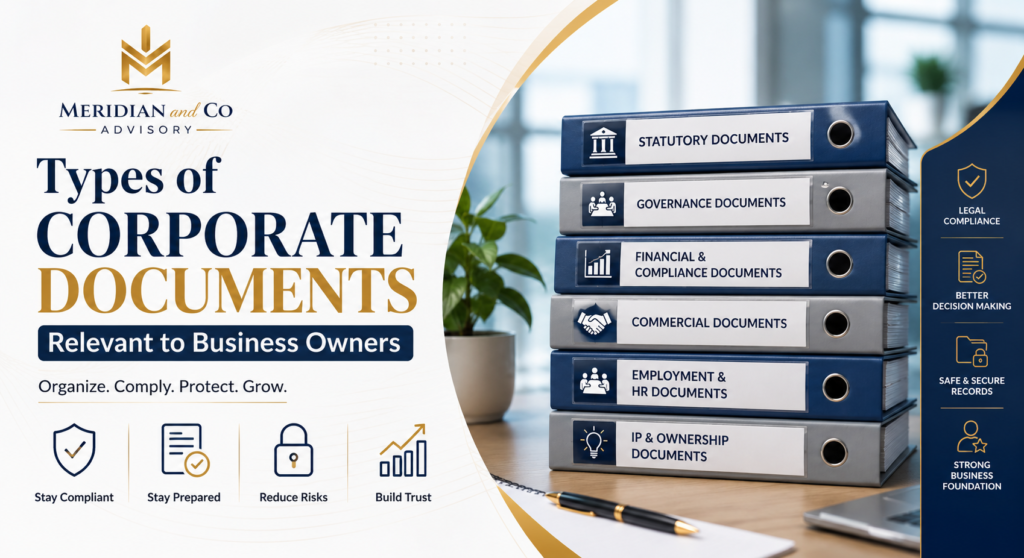
Most corporate documents will fit into one of six categories. The exact documents a business must keep and the period for which it must retain them will depend on the business’s structure, its activities, and the applicable Indian laws and compliance requirements.
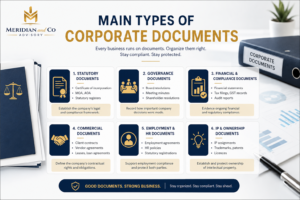
| Category | Examples | Why they matter |
| Statutory documents | Certificate of incorporation, MOA, AOA, statutory registers | Establish the company’s legal and compliance framework |
| Governance documents | Board resolutions, meeting minutes, shareholder resolutions | Record how important company decisions were made |
| Financial and compliance documents | Financial statements, tax filings, GST records, audit reports | Evidence ongoing financial and regulatory compliance |
| Commercial documents | Client contracts, vendor agreements, leases, loan agreements | Define the company’s contractual rights and obligations |
| Employment and HR documents | Employment agreements, HR policies, statutory registrations | Support employment compliance and protect both parties |
| IP and ownership documents | IP assignments, trademarks, patents, licences | Establish and protect ownership of intellectual property |
Statutory Company Documents
Certain statutory documents form the legal and compliance foundation of a company. They establish its structure, ownership, and management.
Examples:
Statutory documents include statutory forms like incorporation certificate, Memorandum of Association (MOA) and Articles of Association (AOA), Permanent Account Number (PAN) and Tax Deduction and Collection Account Number (TAN), statutory registers, minutes of board and general meetings, and annual filings and financial statements to the Registrar of Companies (RoC).
Purpose:
These documents provide evidence of the company’s legal status, ownership, management, and compliance when required. They may require regulators during inspections, fundraising, litigation, mergers, or acquisitions.
Importance:
The applicable law requires companies to maintain statutory records for the periods prescribed. They should also periodically check that these records are complete, properly signed and authenticated where required, and stored securely.
Governance Documents: Who Decided What and When
Governance documents record important decisions made by the company. They become particularly important when courts, banks, or investors need to verify how they made a decision.
A board resolution has a practical purpose. Banks may request one before opening an account. Investors may request one before they close a funding round. Without a dated and properly worded resolution with the appropriate signatory, the parties can delay an otherwise agreed transaction.
Essential Documentation Related to Governance
Documents relating to opening or changing bank accounts
- Instructions or approvals authorising the company to enter into contracts or commitments
- Approvals for significant transactions
- Records relating to fundraising or financing
- Documents relating to the appointment or removal of directors and officers
- Approvals for significant contracts or agreements
- Shareholder resolutions and other shareholder decision records
- Other matters requiring formal corporate approval
Financial and Compliance Documents
This category includes the documents a company maintains to meet its ongoing financial, tax, and regulatory obligations.
- Audited financial statements
- Income tax returns
- ROC annual filing documents (AOC-4, MGT-7)
- GST registration and returns
- Statutory audit reports
Retention periods for compliance documents can vary depending on the type of record and the applicable law. Some records may require retention for longer periods than others, so you should check the specific requirement before disposing of them.
Contractual and Commercial Documents
This category includes the agreements entered into by the company and is often one of the more difficult areas to keep organised as the business grows.
- Vendor and supplier agreements
- Client and customer contracts
- Lease and rental agreements
- Non-disclosure agreements
- Loan agreements and security documents
These documents become particularly important during a dispute. A vendor may say the company owes them money, or a client may say that the agreed work was not provided. In such cases, the terms of the contract become important in determining what each party agreed to do.
Employment and HR Related Documents
- Offer letters and employment agreements
- HR policies and employee handbooks
- POSH policy and Internal Committee documentation
- Provident Fund and ESI registration documents
- Full and final settlement records
When it comes to employment disputes, fragmented records make it tough for the business to defend itself. Keeping orderly employment records helps employees understand the boundaries of their employment. An unwritten employment agreement or unsigned company policy does make for a weak defense if the case proceeds to a tribunal.
Intellectual Property and Ownership Documents
- Patent and trademark certificates
- Copyright assignments
- IP assignment agreements with employees and founders
- Licensing agreements
Founders should not assume that all intellectual property created for the business automatically belongs to the company. Ownership can depend on applicable law and the agreements entered into with founders, employees, and contractors.
Why Corporate Documents Matter
Corporate entities cannot simply create and forget corporate documents. They provide a record of important decisions, agreements and compliance activities. A board resolution can record the company’s approval of a transaction and the authority given to a signatory. A shareholders’ agreement can set out what happens when a co-founder exits the company. A statutory register provides a record of the company’s compliance and ownership information.
Losing these documents can result in various costs for the business. The problem can come up during fundraising, a contractual dispute with a co-founder, or an ROC inspection. Missing or outdated compliance documents can also create legal and practical problems for the company.
Understanding the Document Life Cycle
Corporate documents normally go through four stages. They create them, use them, retain them, and eventually archive or dispose of them.
- Creation: They finalize documentation when they draft, sign, execute, or file it.
- Active use: During the active-use phase, businesses use documents in their day-to-day operations. This phase may include processing transactions, reviews, audits, etc.
- Retention: Businesses retain documents for a legally or practically required period.
- Archive and destruction: When the retention period is over, businesses can securely destroy or archive documents that they do not need to retain any longer.
Identifying the stage of the document in the cycle can help define a proper storage period and whether to retain the document. While some businesses may need to retain certain documents for the entirety of their existence, others may need to retain them only for the required retention period.
When Will You Actually Need These Documents?
Most business owners underestimate how often they need these documents outside routine compliance.
- Fundraising: Before closing, investors conduct legal due diligence on almost every category mentioned above.
- Disputes and litigation: Contracts, resolutions, and HR records may become important in determining the outcome of a dispute.
- Mergers, acquisitions or exits: Buyers will usually expect an organised and complete set of corporate legal documents.
- Bank and NBFC transactions: Corporate Banking normally involves board resolutions and statutory documents for opening accounts and availing credit facilities.
Companies that keep their corporate documents in good order will be better prepared to act when such situations arise.
Common Mistakes Companies Make With Corporate Documents
- Not updating statutory registers after changes in directors or shareholding.
- Treating employment and IP documents as optional rather than as important legal records.
- Storing documents on multiple personal devices instead of a central system.
- Not being able to identify which board resolution or agreement is the final signed version.
- Assuming that digital copies are sufficient when someone requires originals or notarised copies.
Most of these problems can be avoided with a basic filing system, but companies often implement one only after a crisis exposes the gaps.
Retention Rules for Business Records in India
There is no single retention period for every business record in India. The applicable period depends on the type of document and the law that governs it.
- Statutory registers and incorporation documents may need to be retained for the life of the company.
- Financial statements and audit records are subject to specific retention requirements under applicable tax and company laws.
- GST invoices and returns are subject to the retention requirements under GST law.
- Employment records may have different retention periods depending on the type of record and the applicable employment law.
- Contracts must be retained for the applicable contractual and legal period, and longer when one anticipates a dispute or litigation.
One of the most common errors is treating records as if they all have the same retention period. Records often have different disposal periods and varying lengths for which they may be subject to retention. If we can tell the difference, we would waste less storage and run less of a risk of noncompliance.
Which Corporate Documents Should Be Preserved in Original Form?
Most corporate documents allow organizations to store them digitally for everyday use. Some documents require individuals to preserve them in their original form or in a certified or notarised form, depending on the document and the applicable requirements. For internal purposes, and for certain regulatory submissions, you may find that a scanned document suffices. Before you dispose of or archive an original, you should carefully check whether the original needs to be preserved.
Where a document is subject to specific requirements regarding originals, stamping, registration, or certification, the necessary personnel should preserve the required original or certified form separately in secure but accessible storage.
Who Should Be Accountable for These Documents?
In most small and medium enterprises, the company secretary, compliance consultant, finance team, and a founder divide the tasks associated with preparing corporate documents. While this can work initially, it will cause problems as the founder becomes busier, as the consultant changes, and as the business grows.
A clearer approach is to assign ownership by category. Statutory company documents and governance records can sit with the company secretary or legal advisor. Finance and compliance records can sit with the relevant finance or compliance owner, while contracts should have a clearly assigned business owner with copies maintained in a central legal repository.
This ensures that an employee’s departure does not leave important records inaccessible or create gaps in the company’s records.
Building a Simple System to Stay Organized
No special software is required to manage this. A system of digital or physical folders, organised according to the categories above and reviewed after each board meeting, filing, or new contract, can help a growing business stay organised.
The aim is simple: when someone asks for a document, you should be able to find it quickly.
Getting Your Corporate Documents in Order
The challenge for most growing companies is not knowing which types of corporate documents are required. It is keeping signed versions of those documents updated, organised and easy to find.
At Meridian and Co Advisory, we help founders and compliance teams organise and maintain corporate legal documentation as part of our advisory services. This helps businesses stay prepared when documents are requested by banks, investors or regulators.
If your corporate documents need to be reviewed, we would be happy to discuss how we can assist.
Conclusion
Corporate documents do not merely serve as records for compliance purposes; they form the foundation for how a business establishes ownership, makes decisions, assesses financial position (via accounting), determines contract status, manages employment matters, and protects intellectual property. When businesses maintain well-organized, duly signed, and terabyte-level stored records of these documents for the required time period, they enable themselves to respond with authority to audits, due diligence, disputes, banking requirements, and regulatory reviews.
By aiming for clarity when organizing these documents, and by retaining the right record when the need arises, a growing business can effectively meet its needs. Furthermore, compartmentalizing each category and systematically reviewing documents from time to time will help businesses avoid the risk of missing records, thereby preventing avoidable compliance gaps.



Pingback: 10 Characteristics of Successful Family Businesses in India
Pingback: Board Resolutions: Why Documentation Protects Company India
Pingback: Succession Planning for Family Business in India: Legal Roadmap