
Why Family Businesses Are Different
A family business isn’t just a company where the shareholders happen to share a last name. There are usually three things happening at once: the family, ownership and management, and they’re rarely separate for long.
The same person might be someone’s father over breakfast, their CEO by 10 a.m., and their fellow shareholder by the time the board meeting starts. That overlap can be a real strength. It can also get messy fast. A business disagreement turns into a family disagreement. A dividend decision becomes an argument about who’s sacrificed more. A performance conversation suddenly feels like a question about someone’s place in the family altogether.
The fix isn’t pulling the family completely out of the business; that’s neither realistic nor the point. It’s understanding where the family relationship ends, and the business role picks up.
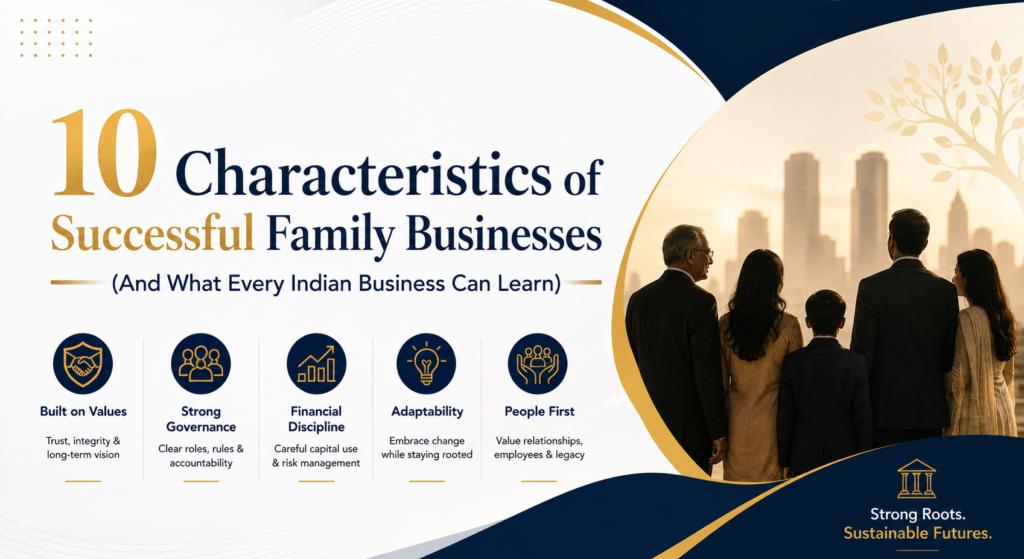
10 Characteristics of Successful Family Businesses
1. Trust comes first, but they don’t leave everything to trust
Most family businesses start informally. A founder trusts a brother to run the factory floor. A parent tells a child they’ll take over one day. Two siblings shake on how profits will be split. Nobody sits down on day one thinking, “let’s plan for every disagreement we might have twenty years from now”, and honestly, why would they? When it’s just two or three people involved, trust makes everything simpler. There’s no need to turn every conversation into a legal document.
But time changes things. The brother who was happy reinvesting profits a decade ago might now need a steady income. The child who once wanted to take over might build a career somewhere else entirely. New shareholders show up. And the issue usually isn’t that anyone stopped trusting anyone;e it’s that everyone quietly remembers the original agreement a little differently.
This is where documentation earns its keep. A shareholders’ agreement, properly recorded ownership, clearly defined responsibilities none of that has to make a business feel less personal. More often than not, it does the opposite. It stops people from having to argue, years later, about what was supposedly agreed to in the first place. The point was never to replace trust with paperwork. It’s making sure trust isn’t being asked to do a job that structure would do better.
2. They think about what they’re leaving behind
Family business owners tend to think about time differently. The question isn’t always “how much can we make this year “; it’s often closer to “will this business still be standing when my kids are the ones running it?”
That shifts how people think about money and growth. A family might reinvest profits instead of pulling them out. They might steer clear of debt that could put pressure on what’s already been built. They might keep supporting employees who’ve been around for years, even through a rough patch.
There’s real strength in that kind of thinking. But it comes with a trap. “We’ve always done it this way” has a habit of becoming the excuse for not changing something that clearly needs to change. The businesses that get this right understand there’s a difference between protecting the values that built the company and protecting every process the founder happened to introduce twenty years ago.
The next generation might bring in new technology, a different management style, or a completely different read on what customers now expect,t and that doesn’t automatically make the older generation wrong, or the younger one right. What matters is whether the family is open enough actually to talk it through.
3. They treat the family’s money with real care
Risk feels different when it’s your own family’s money on the line. A business owner in this position isn’t just weighing a return on investment; they’re thinking about savings, property, employees, and whatever their kids might eventually inherit.
That usually makes family businesses more careful with capital. They tend to prefer steady growth over aggressive expansion, reinvest profits rather than chase every opportunity, and think twice before taking on serious debt. That discipline is genuinely valuable. But there’s a point where caution becomes its own kind of risk, where a family gets so worried about losing what it’s built that it stops investing in anything that could actually move the business forward.
The better question isn’t “is this risky?” Almost everything worth doing carries some risk. The more useful question is: if this goes wrong, can the business and the family absorb it? Responsible ownership isn’t about avoiding risk altogether. It’s about knowing exactly which risks you can afford to take.
4. They value loyalty, but they don’t confuse it with ability
Spend a few years around an established family business,s and you’ll meet someone who’s been there almost as long as the business itself. They know the customers, the suppliers, exactly how the founder likes things done, and they can probably tell you how a problem from fifteen years ago got solved. That kind of institutional memory is hard to replace.
But loyalty shouldn’t work as a shield against accountability,y and that goes for family just as much as it does for anyone else. Being someone’s son, daughter, brother, or cousin doesn’t automatically make them right for a particular role. A family member running finance actually needs to understand finance. Someone managing operations needs to be capable of managing operations. Someone on the board needs to understand what being a director involves genuinely. That’s not being harsh; it’s being fair to the business, and honestly, often fairer to the family member too. When expectations are clear from the start, there’s a lot less room for resentment down the line.
5. They move fast without making the founder impossible to replace
One of the real advantages of a family business is speed. The person who can approve something is often just sitting right there. A customer calls in with a problem, an opportunity comes up, a supplier needs an answer,r and there isn’t necessarily a long chain of sign-offs standing in the way.
But there’s a line between speed and dependency. If the founder still has to approve every major decision twenty years in, that’s not really a strength anymore; re it’s a warning sign. Not because the founder’s doing anything wrong, but because nobody else has actually been handed enough authority to act on their own.
Succession tends to expose this pretty quickly. A founder might officially step down as CEO, but employees keep calling them anyway. Customers still ask to speak to them directly. Senior managers still wait to hear what they think before moving forward. That’s not really a handover; it’s delegation with a new job title stapled on. A growing business needs real clarity about who can decide what: what falls under management, what needs board approval, and what’s reserved specifically for shareholders. The goal was never more bureaucracy. It’s simply fewer moments where everyone’s stuck waiting on one person.
6. They make sure customer relationships belong to the business, not just the founder
Family businesses often build extraordinary relationships with their customers, the kind where a client’s been dealing with the founder for twenty years, where they know each other’s families, and where they’ve been through good years and bad ones together. That trust is genuinely valuable. But it can also become a succession problem.
If a customer says, “I only deal with your father,” the relationship was never really transferred to the business; it stayed with one person. That shift doesn’t happen overnight. It usually means the founder gradually introducing the next generation, senior staff becoming more visible to clients, and customers slowly experiencing the same reliability even when the founder isn’t personally in the room. The point isn’t erasing the founder’s role. It’s making sure the business doesn’t collapse the moment that one relationship steps back.
7. They talk about succession before there’s a crisis forcing the issue
Succession is one of those conversations every family knows it should have and keeps putting off anyway. The founder’s healthy, the business is doing well, the kids aren’t quite ready, and there always seems to be more time. So it gets pushed to next year. And then something happens: a health scare, a falling-out, an unexpected death, a big decision nobody’s prepared for, or simply the realisation that the “next generation” has quietly grown into adults with careers, opinions, and plans of their own. And just like that, succession stops being optional.
Succession was never only about naming the next CEO, either. There’s a whole set of questions tucked inside that one word: who owns the shares, who actually runs the company, who sits on the board, who receives the dividends, what happens if someone wants out, what happens if one child wants in and another doesn’t and, perhaps hardest of all, what happens if the person everyone assumed would take over isn’t actually the right fit to run things. Ownership and management don’t have to travel together. A family member can stay a shareholder without ever becoming CEO. A professional manager can run the company perfectly well without sharing the family name. The right answer really just depends on what serves the business and the family best.
8. They know when they’re acting as family and when they’re acting as businesspeople
This might be the single hardest thing for a family business to get right. A father can be the CEO. His daughter, an employee. His son, a shareholder. A cousin might sit on the board. And that evening, they’ll all be back at the same dinner table.
The trouble starts when those roles get tangled together. A disagreement at the board table turns into a fight between siblings. A performance review turns into a parent-child argument. A dividend decision becomes a debate about who’s sacrificed more for the family over the years. The answer isn’t distance; family members don’t need to become strangers at work. They just need to be clear about which hat they’re wearing at any given moment. A director has director responsibilities. A shareholder has shareholder rights. An employee has performance expectations to meet. None of that disappears just because everyone shares a surname.
9. They protect the family name by building a reputation that can outlast the founder
For a lot of family businesses, the family name basically is the brand,d which creates a strong sense of responsibility. A customer complaint feels personal. An employee dispute feels embarrassing. A bad call can feel like it reflects on the entire family, not just the business.
But there’s a real danger when the company’s whole reputation rests on one person. If everyone trusts the founder but nobody quite knows the next generation yet, the handover gets a lot harder than it needs to be. The long-term goal is for customers to trust the company itself, not just the person who started it;t for employees to understand the standards, for customers to know exactly what level of service to expect, and for management to answer to systems rather than simply to the founder’s presence. The founder builds the reputation. The organisation has to learn how to carry it on its own.
10. They professionalise without losing the family’s identity
The word “professionalisation” tends to make family businesses nervous; it sounds like bringing in outsiders, piling on paperwork, and turning something personal into something cold. That’s not really what it means in practice.
A founder can often personally handle sales, finance, hiring, and every major decision when the business is small. But eventually it grows. The children join. Ownership gets divided. Different family members start wanting different things: one wants to expand, one wants dividends, someone else is thinking about selling entirely. At that point, the old informal arrangement simply isn’t built to hold all of that weight anymore. Professionalising, in practice, might mean better financial reporting, clearer management roles, a board that actually functions, defined shareholder rights, a real succession plan, and an actual process for resolving disagreements. It doesn’t mean taking the family out of the business. It means giving the business enough structure to handle the family becoming more complicated over time.
The Three Circles: Family, Ownership and Management
A simple way to picture all of this is as three overlapping circles: family, ownership and management.
- Family is the relationship side: who’s part of it, who wants to be involved, and what the family expects from the business.
- Ownership is about shares and economic rights: who owns what, who gets dividends, what happens if someone wants to sell.
- Management is about actually running the business: who makes the operational calls, who manages people, who’s accountable for performance.
In the first generation, all three circles usually belong to one person: the founder is family, owns the business, and runs it. By the second or third generation, that picture can look completely different. One relative might hold shares without ever working in the company. Another might run daily operations while owning very little. A professional CEO might manage the whole thing without being related to anyone at all. None of that is inherently a problem. The real issue only shows up when nobody’s actually sat down and talked through how those three circles are supposed to work together.
What Family Business Governance Can Actually Look Like
There’s no single governance template that fits every family. A business with one founder and two shareholders doesn’t need what a third-generation company with several family branches holding shares needs. But as things get more complicated, a handful of tools tend to become genuinely useful.
- A shareholder’s agreement sets out what happens when someone wants to transfer shares, exit the business, or when shareholders disagree, covering things like shareholder rights, transfer restrictions, decision-making, and dispute resolution. What matters most is that it actually reflects the real family and business, not just a standard document signed once and forgotten.
- A family constitution does something different. It helps the family agree on things like who can join the business, what’s expected of family members who do, how the family participates in governance, and how disagreements get handled. It’s less about corporate mechanics and more about building a shared understanding.
- A succession plan shouldn’t just say “the eldest child takes over.” It needs to account for ownership, management, governance, timing, and preparation, and it needs revisiting, because families and businesses both change.
And a clear decision-making structure means everyone knows which calls belong to management, the board, shareholders, or the family as a whole. That clarity, oddly enough, tends to make the business faster; people spend less time asking “who needs to sign off on this” and more time just getting on with it.
Does Governance Make a Family Business Feel Less Like a Family?
This is probably the concern we hear most. “If we start putting everything into agreements, doesn’t it stop feeling like ours?”
Usually, we’ve found it’s the opposite. Take something as simple as one sibling wanting to leave the business. If the family agreed years earlier on what happens to their shares, that conversation stays practical. If nothing was ever agreed, everyone has to negotiate the rules for the first time exactly when someone’s already upset,t and that’s precisely when a business disagreement turns into a family one. Good governance doesn’t replace trust. It just means trust isn’t the only thing holding the whole relationship up.
What Any Growing Business Can Learn From This
You don’t need a family business to take something from all of this. Build relationships that survive any one person leaving a company; a company shouldn’t lose its best customers just because a founder retires. Think long-term, but stay willing to change course. Treat capital carefully, since growth only helps when the business underneath it can actually support it. Put the important things in writing, not because people don’t trust each other, but because it protects a good relationship from two different memories of the same conversation. Reward loyalty without letting it replace merit; long-serving people matter, and so do capable people who joined last month.
Move quickly without making one person indispensable. Start succession conversations early, while everyone’s healthy and the business is stable. Separate ownership from management where it makes sense; owning a company doesn’t automatically mean you should run it. Build a reputation that belongs to the organisation, not just one name. And let governance evolve with the business, because what worked for the founder might not work for the third generation, and that’s not bureaucracy creeping in; it’s just what happens as a business grows up.
What We’d Tell Our Own Families And What We Tell Our Clients
If there’s one thing we’ve learned from seeing family businesses from both sides, it’s this: the qualities that build a family business aren’t always the ones that protect it as it grows. Trust builds the company. Loyalty keeps people together. The family name creates a reputation. Long-term thinking carries the business through the hard years. But eventually, harder questions show up :p Who owns what, who decides what, who’s actually running the business, what happens when someone wants out, what happens when family members simply disagree, and what happens when the founder isn’t there anymore to smooth things over.
The families who handle these questions well don’t wait for them to become crises. They talk about them while the business is healthy, while relationships are still strong, and while everyone still has real choices in front of them. That’s really what governance is about: ut not taking the family out of the business, not replacing trust with paperwork, and not turning something personal into something cold. It’s about giving the business enough structure to survive the family growing. Because the goal was never just to build something your children can inherit; it’s to build something they still have a reason to believe in once it’s theirs.
How Meridian Helps Family-Owned Businesses
Meridian works with family-owned businesses and founders on succession planning, shareholder arrangements, and family-business governance. We don’t start with a generic template; every family has its own history, every business has its own ownership structure, and every generation brings its own expectations. The right approach reflects how the family and business actually work today, while getting them ready for what’s next.
If your family business is heading into its second or third generation, bringing new family members into ownership, or simply becoming too complex to run on trust and memory alone, it might be worth starting that conversation now. In contrast, the business is healthy, the family can still sit around the same table, and everyone still has room to plan for the future instead of reacting to a crisis.
Talk to Meridian about building a structure that protects both the business and the relationships behind it.


Pingback: Succession Planning for Family Business in India: Legal Roadmap