
Why the Business Structure Determines Your Succession Options
The most important succession planning decision is not who inherits it is what legal structure the business is held in when the succession happens. Structure determines what can be transferred, how, and whether the business survives the transfer.
| Business Structure | What Happens on Owner’s Death | Succession Options |
| Sole proprietorship | Business legally ceases to exist. Heirs inherit assets only – not ongoing business. | Convert to Pvt Ltd before succession (recommended). Family settlement deed for assets distribution. Will for asset transfer to heirs. |
| Partnership Firm | Dissolved unless the partnership deed expressly provides for continuation with surviving partners or legal heirs | Include continuation clause in the deed. Admit heir as a partner. Or convert to Pvt Ltd or LLP. |
| Private Ltd | Perpetual Succession – company continues regardless of owner’s death. Shares transfer per will, nomination, or transmission rules. | Shares transmit to legal heirs. SHA governs. AOA transfer restrictions apply. |
| LLP | Continues as a separate legal entity. Designated partner’s interest transfers as per LLP agreement | LLP Agreement must specify succession provisions. Partner’s estate inherits economic interest, not management rights. |
Converting a Proprietorship to a Private Limited Company for Succession
A sole proprietorship cannot be inherited as a going concern it has no separate legal identity from its owner. Converting to a private limited company creates perpetual succession- the company continues regardless of what happens to any individual shareholder or director. This is the single most impactful legal action a proprietor can take to protect a family business for the next generation.
The conversion process under the companies 2013 involves:
-
- incorporating a new private limited company through SPICe+ on the MCA V3 portal the proprietor and at least one other family member the intended successor are typically the founding directors and shareholders
-
- executing a business transfer agreement– transferring all assets liabilities contracts and goodwill of the proprietorship to a new company.
-
- Migrating GST registration– the new company requires a fresh GST registration the proprietorships registration is surrendered.
-
- updating all licences bank accounts and contracts from the proprietorship to the company name.
Capital gains tax treatment: Section 47 (xiv) of the Income Tax Act 2025 provides a capital gains exemption on the transfer of proprietorship’s assets to a successor company, subject to conditions including that the proprietor holds at least 50% of the company’s voting power for a minimum.
Verify the current conditions with a qualified CA — the 2025 Act revised the section number from the earlier 1961 Act.
For the statutory framework on succession of a sole proprietary concern by a company, see Section 47 of the Income Tax Act framework. The provision sets out conditions including transfer of the business assets and liabilities and the proprietor retaining at least 50% voting power for five years.
Family Settlement Deed vs Will: Which Succession Document Do You Need?
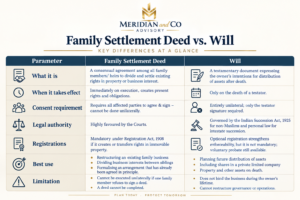
These are the two most commonly confused succession documents in Indian family business planning. They serve different purposes and have different legal effects many families need both.
| Parameter | Family settlement deed | Will |
| What it is | A consensual agreement among all family members/ heirs to divide and settle existing rights in property or business interest | A testamentary document expressing the owner’s intentions for distribution of assets after death |
| When it takes effect | Immediately on execution, creates present rights and obligations | only on the death of a testator. |
| Consent requirement | Requires all affected parties to agree & sign –cannot be done unilaterally. | Entirely unilateral; only the testator signature required. |
| Legal authority | Highly favoured by the Courts. | Governed by the Indian succession act 1925 for non-Muslims and personal law for Intestate succession |
| registrations | mandatory under registration act 1908 if it creates or transfers rights in immovable property | optional registration strengthens enforceability, but it is not mandatory voluntary probate still available |
| Best use | restructuring an existing family business dividing business interests between siblings formalising an arrangement that has already been agreed in principle | planning future distribution of assets including shares in a private limited company property and other assets on death |
| Limitation. | cannot be executed unilaterally if one family member refuses to sign a deed cannot be completed | does not bind the business during the owner’s lifetime cannot restructure governance or operations |
Daughter’s Inheritance Rights: Plan for Them, Not Around Them
The Hindu succession amendment Act 2005 granted daughters equal coparcenary rights in Hindu joint family property including business interests held in an HUF. The Supreme Court in Vineeta Sharma vs Rakesh Sharma confirmed this applies regardless of whether the father was alive when the ACT came into force.
In practise, this means any succession plan for a Hindu family business that does not account for daughter’s inheritance rights is legally incomplete and potentially challengeable. Succession plans built on an assumption that daughters will not take their share rely on voluntary relinquishment, which is valid if genuinely consensual and properly documented, but which courts scrutinise closely for coercion.
The legally sound approach: include daughters in the succession plan, document their participation or any relinquishment through properly executed and registered instruments and reflect the agreed outcome in the family settlement deed and the company’s shareholder register.
The Hindu Succession (Amendment) Act, 2005 introduced the amended Section 6 framework for daughters as coparceners in a Mitakshara joint Hindu family.
The Supreme Court’s decision in Vineeta Sharma v. Rakesh Sharma addressed the application of the amended Section 6 and confirmed the equal coparcenary status of daughters.
Governance Documents: What Must Be Updated Before Ownership Transfers
Succession planning is not complete when the family agrees on who gets what. It is complete with the companies governance documents reflect the new reality and can withstand a legal challenge from any party including a dissatisfied hire.
The documents that must be reviewed and updated as part of any family business accession:
Articles of Association
Articles of association: share transfer restrictions, transmission procedures on death, director appointment and removal rights, and pre-emption rights must all reflect the post succession ownership structure. A generic table F AOA is not adequate for a family business succession.
Shareholders’ Agreement
SHA: governs the rights and obligations between the successor generation as co-owners. Must cover management roles, profit distribution, deadlock resolution, buy -sell provisions, drag along and tag along rides and what happens if a successor wants to exit.
Family Constitution
Family constitution for larger family businesses: a non-legally binding governance document that sets out the family’s agreed values, employment policy for family members, dividend policy, and dispute resolution process. Increasingly common in second generation Indian family businesses.
Buy and Sell Agreement
Buy and sell agreement: specifies what happens to a shareholder’s stake on death, incapacity, or retirement. Requires a pre agreed valuation methodology and a funding mechanism- typically a key person’s life insurance policy structured to provide liquidity without straining the business’s cash flows.
For related corporate governance and documentation work, see Meridian’s Corporate Documentation Services, which covers corporate and governance documents businesses need to maintain.
Final Thoughts
The families that navigate business succession successfully are not the ones that had the least conflict- they are the ones that documented their agreements early, in the right legal form, aligned across their company’s governance documents. A family settlement deed that contradicts the AOA, a will that ignores pre-emption rights in the SHA, or a proprietorship with no succession are all avoidable problems. They become unavoidable only when they are left unaddressed.
At Meridian and Co, we work with family businesses on succession structuring- from converting proprietorships to private limited companies, to drafting family settlement deeds, and updating governance documents for the second generation. If you are planning a transition or want a legal review of your current succession structure reach out to our team through our mail.
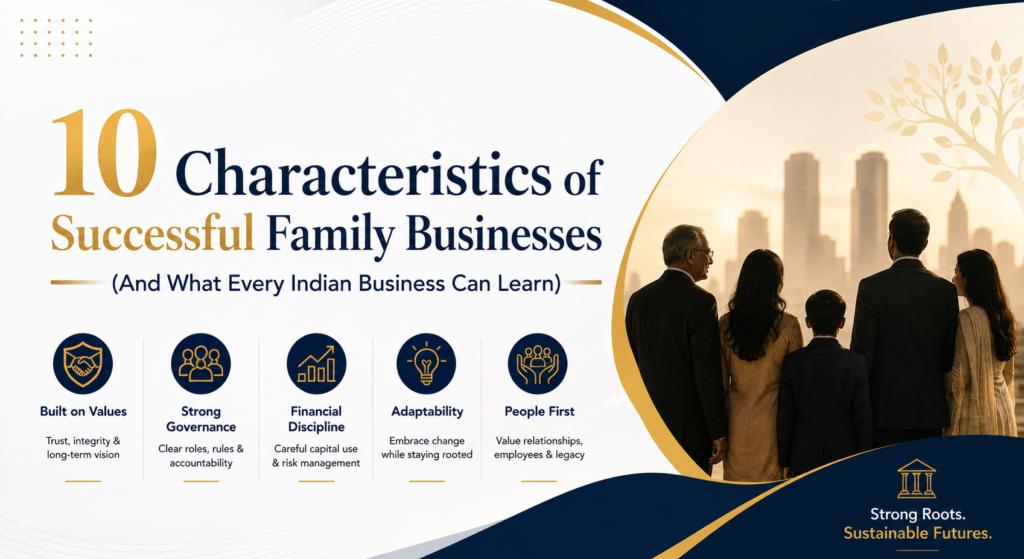
For broader context on family-business governance, you can also internally link this article to Meridian’s 10 Characteristics of Successful Family Businesses in India. That article already discusses shareholder agreements, family constitutions and succession planning.